Leadings of the Spirit

As many as are led by the Spirit of God, are the sons of God. Romans 8:14

During my college years, I received some inward direction about decisions that had important  consequences.  These inward promptings related to a sense of a mysterious destiny or purpose for my life.  I would not, at the time, have called them “leadings of the Spirit,” but that’s what they were.  Only several years later did I begin to understand that I–along with others–had been born to participate in God’s healing purposes for humanity and the earth.

Some of the ten elements of the Quaker spiritual journey I’ve described in this blog are infrequently discussed today.  Leadings, however, are commonly identified.  Friends in our time have created the clearness committee process to help one another discern when an inward prompting comes from God and when it comes from another source.  Many of us have discerned leadings from the Spirit of God and have followed them with the desire to be as faithful as possible.  In this we share a common understanding with early Friends.

I do not remember seeing the word leading in the writing of seventeenth-century Quakers.  More often they spoke of feeling a “drawing” or of receiving an “opening” to do something, or of having a “weighty exercise” placed upon them.  Many wrote of being “moved of the Lord” or “commanded of the Lord” to do a particular act.  Romans 8:14 was quoted by many of them, and on at least one occasion in court, William Dewsbury quoted this piece of scripture using inclusive language:  As many as are led by the Spirit of God, are the Sons and Daughters of God.

As a person grows in sensitivity to God’s loving desires for life on earth, particular human ways that are contrary to divine Love and Truth become more evident and more painful to endure.  People who desire to be faithful may experience a special burden being placed on them in relation to some particular need or wrong or injustice in the world.  This is often described as being “exercised” about something, or having a “concern” placed upon one.  Since the beginning of Quakerism, some Friends have felt a concern to address the spiritual alienation and oppression that lie at the root of all addictive and harmful behaviors and unjust social systems. 

Individuals or groups on whom a concern has been placed or who are called to undertake a particular kind of ministry may then experience God leading them to take some particular action.  Early Friends usually experienced promptings, first of all, to faithfulness in the particulars of daily life.  Barbara Blaugdone felt God asking her to give up the fancy clothing and flattering speech that marked a higher social status, and then to simplify her diet: “As the Evil was made manifest, I departed from it, and willingly took up the Cross, and yielded Obedience unto it, in plainness of Speech and in my Habit [clothing]….  And then the Lord caused me to abstain from all Flesh, Wine and Beer whatsoever, and I drank only Water for the space of a whole Year; and in that time the Lord caused me to grow and to prosper in the Truth.” (qtd. in Garman et. al., 275-276.)

Ordinary  people–farmers, artisans, tradesmen, mothers and fathers, sons and daughters–were led by God to civil disobedience in the form of refusing to pay mandatory tithes to the state church. They also gathered publicly in meetings for worship, which were forbidden.  Many were put in prison for such things, and other members of the community felt led to offer support to the prisoners and their families.

Concerns, calls, and leadings are not general precepts learned from reading scripture and listening to sermons.  Although early Friends believed that any genuine prompting from God was consonant with scripture and a holy life, calls and leadings are guided from within by the still small voice of God or by an unmistakable inward movement of the Holy Spirit.  Seventeenth-century Quakers read the scripture stories of prophets, saints and holy people with the understanding that God wanted to work in their lives in the same way.  As they surrendered to divine promptings and responded faithfully to the calls and leadings they received, they learned to let God–through Christ–be the initiator of their actions, and also the power that made everything happen.  In this way, they gradually allowed God to incarnate more fully in the world.

William Caton, a young man who had been brought up in the household of Margaret and Thomas Fell, became a Quaker traveling minister at a young age and was led to bring the Quaker message to Holland.  He wrote a letter describing a leading he felt to marry a young Dutch woman named Annekin Diericx: “I felt a] mighty clear opening of my proffering of my self to take [Annekin’s] part in marriage….  This thing settled in me, and grew clearer and clearer, neither could I expel it as heretofore I could have done [a] flashing thought which have come as lightenings in some cases,…  for the longer it continued the more assurance I came to have in my self, of the thing being of the Lord….  And in the mean time it came to be shown unto me, how I should proceed in the thing:  As first of all…I was to propound it to some dear friends to hear and receive their advice…and so much subjection I found then in my spirit that if they…had no unity with the thing that then I could (I believe) have let the thing have fallen and have rested satisfied in myself about it…. (qtd. in Mack, 159.)  This is one of the earliest written descriptions of a Quaker seeking “clearness” about a leading to marriage.

Margaret Fell felt a concern about the growth and spiritual health of her newfound Quaker community, and she received a call to nurture the community with all the skills and resources at her command.  She responded  by holding a regular meeting for worship in her home, by providing hospitality to traveling Friends, by maintaining a network of communication and care, by collecting and distributing funds, by writing epistles and tracts to communicate the Quaker message, by traveling in the ministry, and by working for the release of Quaker prisoners.  Within the scope of her wide call to ministry in these forms, she received many leadings to particular actions. 

Many early Quakers felt called to leave home and travel in the ministry, speaking, writing, and teaching about a more true and loving way for human beings to live.  In seventeenth-century England and the colonies, they were often imprisoned for doing so.  Elizabeth Hooton, the second Quaker traveling minister, responded boldly to the leading she received and quickly landed in prison, along with George Fox.  William Dewsbury heard the call years before it was time to leave his family and home.  James Nayler and Marmaduke Stephens heard God speak to them directly, while plowing their fields.  Francis Howgill received his call after an intense experience of surrendering to God and experiencing a new birth.  Each time these courageous Friends were released from prison, they listened for the next leading, sometimes struggled, and then obeyed. 

Leadings of the Spirit: How have you or someone you know been led by the Spirit to undertake a particular action, big or small?  How did you know you were experiencing a leading from God and not being motivated by something else?  Did you resist the leading?  If you followed your leading, what were the fruits?  What helps us respond faithfully to a leading?

narrow gate

 * * * * * This post is part of a series about Ten Elements of the Quaker Spiritual Journey. The  next post will describe Friends’ experiences of Leadings in our time.  Please respond and share your own experience!

 A Whole Heart has pages on Bibliography  and Upcoming Workshops.

 c) 2013 Marcelle Martin

Posted in Learning from Early Friends, Quaker Faith Today | Tagged , , , , , , , , , , , , , , , , , , , , , | 7 Comments

Gathered Into Community Today, part 2

One Friend asked: “In addition to worship, do you have any information about the hard-and-fast ways that early Friends “gathered into community”? Did they have Friendly Eights or a potluck? Did they meet to hear about the newest project of their local Quaker institution?” 

This tongue-in-cheek question highlights how many of us think about community today.  To my knowledge, early Quakers did not organize events for the primary purpose of fostering or creating community.  Daily they prayed and meditated on scripture.  Then, during lengthy and frequent meetings for worship, they were brought together by the power of God, united into a spiritual body.  Almost as important, they depended upon one another to live faithfully in a hostile culture.  This helped forge deep spiritual bonds among them. 

Friends today still experience spiritual oneness during gathered or covered worship, but such experiences are less common.  Apart from worship, probably the most powerful way that Quakers experience being gathered into spiritual community today is when jointly carrying out a leading, especially when it carries a risk.  In an article entitled “People and Peoplehood,” Quaker Theology editor Chuck Fager discusses early Friends’ sense of call to be a people of God.  In it,  he shares an experience of his own.  On a spring day in 1967, he crossed the Canadian border at Ft. Eire on the Peace Bridge, one member of a group of New York Quakers carrying medical supplies to be shipped by the Canadian Friends Service Committee to civilian victims on all side of the Vietnam War.  In obedience to a leading of the Spirit, these Quakers were defying the law and committing civil disobedience.  They announced their intention to the Border Patrol. 

Fager wrote, “I smiled all the way across the bridge, and I remembered especially the warm greetings of the Canadian Friends who met us.  That was a very special moment in my young Quaker journey.  And in reflecting on what made it so special, this word “peoplehood” came back into my mind.  That walk over the bridge, and the reception we got from Canadian Friends, was the act of a self-conscious people, a group with an identity and a mission; and that day, these realities were clearly in focus for me, if not yet articulated.”

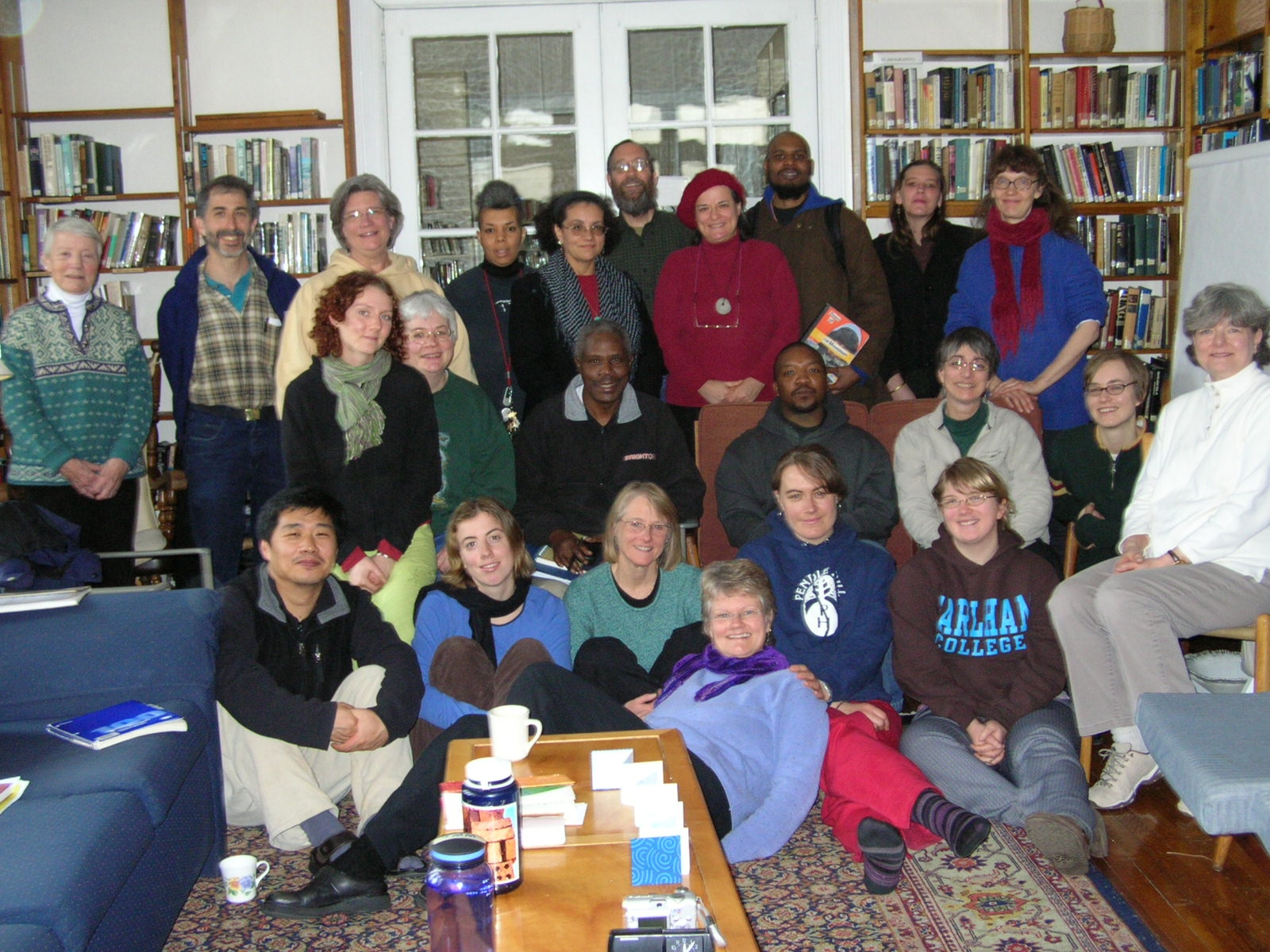
Reflecting on what helps and hinders community, Elizabeth Ann Blackshine shared some contrasting experiences.  During a year spent at Pendle Hill retreat center, she was part of a powerfully transforming community.  She wrote, “my time at Pendle Hill, with a very racially diverse group, was indeed the most gathered I felt in a spiritual community to date among Friends. Never had I been so ripe for healing and transformation than that year and never had I been so deeply met and supported than at that time. I attribute it to the many elders who were there that year. They and other seasoned Friends offered such a deep holding space, that unquantifiable quality of cultivating the air of love in every corner of a space, of having the love generator on 24/7 that allowed me to heal and transform deeply, feeling so spiritually and soulfully held. The willingness to be deeply vulnerable, exposed, fully present from all Friends is a big factor. That year at Pendle Hill was such a beautiful balance of holding on to a core of Quaker principles, with an encouragement to have meetings for worship with a concern for just about any topic one was drawn to.  There was such a wide container for Spirit to fill.”

She did not find this kind of wide community, however, in a meeting she attended that was “full of the unresolved conflict and prejudices that affect Friends today.”   She has found similar dynamics in other Quaker groups: “While I find the worship completely dynamic, unlike any other form of gathering and worship that I’ve experienced, I seem to run into road block after road block socially among Friends. My perception is that it’s race-based on both sides. This is not an accusation but more a shining of light on a deep wound that all Friends could benefit from looking at and pouring attention to for Spirit to continue to slowly heal.  I’m so thankful for the Friends who are doing that on their racial and social justice committees and for Friends like Donna McDaniel and Vanessa Julye whose book Fit for Freedom, Not for Friendship has been an enormous resource along this slow journey. I long for more worship sharing around topics of race and other social barriers that still need enormous healing in the nation and therefore, naturally, still in the Society of Friends.” 

Elizabeth prays to help create a nurturing “container” for transformation.  She hopes to “learn to weather more of these storms together and not in isolation. I pray for the courage to participate with a whole heart…” 

Rhonda discovered that over time she grew into her community like a branch on a vine, and that giving and receiving from her Quaker meeting became part of one flow.  John 15:5 speaks to her of community: I am the vine, you are the branches. Those who abide in me and I in them bear much fruit, because apart from me you can do nothing.  This passage resonates with her “relationship with God through the meeting.”  She reports that, “Over the past year or so, we have become more intentional about enhancing the depth of our community and exploring our Quaker roots.  Now, worship feels more vital and we have a clearer sense of the Spirit moving among us.”

She has been surprised to discover how she herself has benefitted while serving her meeting, and how, in doing so, she has become a part of the meeting in a new way: “Over the past couple weeks, I have discerned that I am being led to grow more fully into who God wants me to be through one of the meeting’s ministries. I know it shouldn’t surprise me, but I have a strong tendency to try to ‘go it alone,’ discrediting my role in the community and not believing that the meeting is God’s and the Christ works through the meeting. I thought that I needed to figure out what my spiritual gifts were so I could determine what I needed to do, quite independent of the meeting. Now, I believe that my participation in the meeting has allowed Christ to live in and move through me, so that I, in conjunction with the meeting, might do Christ’s work in the world.”

Gathered Into Community Today: In what ways have you, others, and your meeting been brought together into a spiritual unity or community?  What, if anything, has stood in the way of that?

The Barn at Pendle Hill in Wallingford, PA, USA

The Barn at Pendle Hill
in Wallingford, PA, USA

* * * * * This post is part of a series about Ten Elements of the Quaker Spiritual Journey. The next post will describe Leadings of the Spirit. * * * * *

A Whole Heart has pages on Bibliography, Articles & Interviews, and Upcoming Workshops.

(c) 2013 Marcelle Martin

Posted in Learning from Early Friends, Quaker Faith Today | Tagged , , , , , , , , , , , , , , , , | 2 Comments

Gathered into Community Today

I’ve been thinking about how God gathers us today and pondering the experiences and questions sent by a few readers.  A few days ago at West Richmond Meeting (in Indiana), I heard two different Quaker meetings share stories of faithful witness, and I was moved by the way they had been gathered more truly into community in the process.  Both meetings are called to a witness that challenges the status quo.  In the process of living their faith, they have been tested, and blessed.

Four members of Adelphi Friends Meeting in suburban Washington, D. C. traveled to visit West Richmond Friends Meeting.  They came to give encouragement and to share their experiences of a common leading.  In different ways both communities had been led to publicly welcome and affirm people regardless of sexual orientation.  Members from each meeting told how and why they were led to take up the issue, to study what scripture has to say (and not say) about homosexuality, and to labor with one another to be honest about different views on the matter.

I and many of the forty people present were deeply moved to hear about the Christian love that motivated each meeting to address the issue and faithfully follow where they were led.  In the late 80s, Adelphi Meeting had witnessed a devastating process in another Quaker meeting following a request by two women to be married under the care of the meeting.  To avoid causing such pain to a couple seeking to be married, Adelphi Meeting decided to consider the issue  before any such request came to them.  The visitors from Adelphi spoke passionately about their desire to be a loving community to any young people growing up in their meeting who might discover they were gay.  After years of study, workshops, discussion, and threshing, they approved a minute stating that they would take marriages of same-sex couples under the care of the meeting.  Twenty years later they received the first such request; it came from two women who had grown up in the meeting.  Recently Adelphi Meeting wrote an epistle to Friends everywhere testifying to the spiritual gifts that had resulted from becoming a welcoming and affirming community.

West Richmond Meeting’s story began more recently.  Long-time members told how the meeting has always sought to welcome people who are spiritually seeking.  When they became aware that God wanted them to expand the sphere of their welcome, they began a process that lasted for years.  It involved scripture study, special meetings, and tender, honest communication.  Indiana Yearly Meeting, of which they were faithful and committed members, is not affirming of gay people in positions of leadership and ministry.  Striving to stay within the lines of what is outlined in IYM’s Book of Discipline, West Richmond Meeting did not propose to offer same sex-marriages, but came to unity to announce that they welcome and affirm people regardless of a multitude of differences, including sexual orientation.  They are clear that they are open to appointing gays and lesbians to positions of leadership and ministry in the community, and they welcome committed gay and lesbian couples and their children as families

Faith and Practice (The Book of Discipline) of Indiana Yearly Meeting states that monthly meetings can take a prophetic role within the yearly meeting. West Richmond Friends felt that this is what they were doing.  However, the Yearly Meeting asked them to remove the welcoming and affirming statement from their website. Feeling it would violate their integrity to do so, they refused.  This was followed by years of rejection by some of the leadership and membership of their Yearly Meeting, which recently resulted in a grievously painful split.  A third of the former meetings in Indiana Yearly Meeting have chosen to become part of a new Association of Friends that is forming.  Throughout the process, members of West Richmond Meeting have grieved the separation from their Yearly Meeting and the rupture of long-time bonds of love.  In spite of all this pain, as a meeting they have never wavered in the clarity and integrity of their witness.  They remain united, gathered in the spirit of Christ.

As I listened to the moving stories told by the members of both meetings, I was struck by the way Friends repeatedly used the pronoun “we.”  They were describing something much more than the experiences of individuals.  These were meetings that had been gathered by God, as  faithful bodies.  Aware that there are differences of opinion among them, both communities desire to give space for the expression of minority views.  Yet they have also been gathered into unity on the issue of being welcoming and affirming communities.  They testified to the sense of integrity that comes in clearly stating who they are as corporate bodies.  Adelphi Meeting members said this is helpful to their young people, as well as to visitors.  Their radiant faces testified to the power of the Spirit that has accompanied them through all the time and effort they have expended to be faithful to their leading.  Blessings have come to the community in return.  One member explained that it is neither the minutes the meeting approved, nor the epistle they sent, that is most important, but the ordinary daily ways they live together as community, their faith made plain in small things like giving someone a ride to meeting and the way they are with one another’s children.

Many felt that the evening of sharing these stories of faith in action was a “covered time together.”  We felt the power of the Spirit present.  For the members of West Richmond Meeting, it has been precious to know that Friends from Adelphi Meeting have been holding them in care and prayer during a difficult and trying time, and that Adephi Friends care so much that they traveled from Maryland to Indiana to spend time together.  Forty people came together on Saturday night and again on Sunday morning to share and hear these stories of faith in action, and to encourage one another to take the next steps in faithfulness.  In the process, God gathered us together and made us aware of being part of an even larger body.

The next blog post will share additional stories of how Friends today experience being gathered into community.

 Gathered into Community Today: How have you or your meeting been gathered by God into community?  How has that changed the way you live and love?

JacobsensSheltonsPH06crop1

* * * * * This post is of a series about Ten Elements of the Quaker Spiritual Journey. The next post will describe more experiences of being gathered into community today.

Click here to see the bibliography page.

(c) 2013 Marcelle Martin

Posted in Learning from Early Friends, Quaker Faith Today | Tagged , , , , , , , , , , , , , , , | 1 Comment

Being Gathered into Community

After several years of mostly solitary and intensely inward spiritual experience, I began to worship with Quakers. At that time I dreamed I had been swimming laps in a big pool, developing strength, and now I was being put on a team. This dream was one of many ways I came to understand that henceforth my spiritual journey would not be a solitary one. Joining with a Quaker community, I was gathered into a larger body.  Although the encounter with the Light within has a deeply personal aspect, sooner or later each person discovers that being in spiritual community is an essential part of the faithful life. Without spiritual companions, it is very difficult to sustain an awareness of the indwelling divine presence and to remain faithful to the guidance of the Light.
Many disappointed seventeenth-century seekers turned away from the religious groups and outward rituals they had once practiced with enthusiasm. Only then did they turn within and wait for God to act. For a time, many became isolated, finding no companions in the same condition. Those who experienced their awakening in solitude were afterwards drawn to join with a gathered group, or to write letters if no group was nearby. Other seventeenth-century seekers joined with others to wait together, learning to turn toward the direct inward encounter with God and Christ, without intermediary. Being in the company of others making the same discovery helped all to make the necessary shift of consciousness. Early Friends left many descriptions of tangible and transforming collective experiences of the presence of God, experiences which they often described by saying that “the Power of the Lord was over all.” In such cases, the surrender to God by a whole group was a great aid to each person; together the group was opened to the presence of the Inward Light and the direct teaching of the Spirit of Christ.
One of the most beautiful descriptions of the collective experience of those who became the first Quakers was written by Francis Howgill in 1663: The Lord of Heaven and earth we found to be near at hand, and, as we waited upon him in pure silence, our minds out of all things, his heavenly presence appeared in our assemblies, when there was no language, tongue, nor speech from any creature. The Kingdom of Heaven did gather us and catch us all, as in a net, and his heavenly power at one time drew many hundreds to land. We came to know a place to stand in and what to wait in; and the Lord appeared daily to us, to our astonishment, amazement and great admiration, insomuch that we often said one unto another with great joy of heart: “What, is the Kingdom of God come to be with men? … And holy resolutions were kindled in our hearts as a fire which the Life kindled in us to serve the Lord while we had a being…. And from that day forward, our hearts were knit unto the Lord and one unto another in true and fervent love, in the covenant of Life with God… And thus the Lord, in short, did form us to be a people for his praise in our generation.

A few weeks after his convincement, early Quaker leader Richard Hubberthorne described the bond he now felt with others in the Quaker community: “And to you all the dear family of love, my love is run into you all. You are my relation, father, mother, sisters and brothers, which I must now own and dwell with in amity and love eternally.” (qtd. in Barbour and Roberts, 157.)

Being in community with others desiring to be faithful to God’s inward promptings is a great and usually necessary aid on the spiritual journey. Individuals receive much assistance, both outward and inward, from the group, and at the same time, much is asked from each person, as well. Sharing in the life of the community often functions as the Refiner’s Fire. One is purified and stretched spiritually in the process of learning to listen, communicate, love, support, and forgive the other members of the group.

As a group collectively learns to surrender to God, a powerful spiritual bond develops among fellow souls committed to the same path. Early Friends found this was especially so when they helped one another to persevere in spite of persecution. In his journal, John Banks wrote: “Oh! the days and nights of comfort and divine consolation we were made partakers of in those days together (and the faithful and true of heart still are).  And in the same inward sense, and feeling of the Lord’s power and presence, we enjoyed one another, and were near and dear unto another.  But it was through various trials and deep exercises, with fear and trembling, that on this wise we were made partakers.” (qtd. in Barbour and Roberts, 186.)

For Quakers, church was not a building but a people gathered by God. God endows the community, through its members, with all the necessary functions and spiritual gifts. Among seventeenth century Friends, a way of being church together emerged that the early Quakers called Gospel Order. The Quakers had no paid clergy, and all the members of the meeting bore a share of responsibility for ministry to and maintenance of the community. The Spirit requires each person to give time and resources to meet needs identified by the corporate body, for the sake of furthering God’s work both within the beloved community and in the wider world. In an epistle raising funds for the support of traveling ministers and imprisoned Quakers and their families, Margaret Fell described how all parts of the Quaker body were responsible for the care of those among them in need:

So let love constrain you to love one another, and be serviceable to one another, and that every one may be made willing to suffer for the Body’s sake, and that there may be no Rent in the Body, but that the Members have the same Care one over another; and where one member suffers, all the Members may suffer with it: and here is the Unity of the Spirit and the Bond of Peace.  (qtd. in Garman et. al., 460.)

Katharine Evans and Sarah Chevers, two early Quaker traveling ministers, were imprisoned for three years by the Inquisition.  They came near death during that time, but felt upheld by the presence of God and by the prayers of their community:  “[A]s owls in deserts, and as people forsaken in solitary places; then did we enjoy the presence of the Lord,…and we did see you our dear friends,…and did behold your order, and steadfastness of your faith and love to all saints, and were refreshed in all the faithful hearted, and felt the issues of love and life which did stream from the hearts of those that were wholly joined to the fountain, and were made sensible of the benefit of your prayers.” (qtd. in Mack, 209.)

Being Gathered into Community:  Has being part of a community been an essential element of your spiritual journey?  How did this happen for you?  How do you experience God at work among the members of the community?

Discerning Our Calls Course Pendle Hill 2007 photo by Iris Graville

Discerning Our Calls Course Pendle Hill 2007
photo by Iris Graville

* * * * * This post is Part Ten in a series about Ten Elements of the Quaker Spiritual Journey. The next post will describe people’s experiences today of Being Gathered into Community. Please share your experience!

Click here to see the bibliography page.

(c) 2013 Marcelle Martin


Posted in Learning from Early Friends | Tagged , , , , , , , , , , , , , , | 6 Comments

The Light That Reveals and Transforms

I’ve experienced the revealing and purifying aspects of the Light in many ways.  Sometimes I feel a subtle sense of discomfort after saying or doing something, different from embarrassment about perceived or actual acts of social awkwardness.  When I pay attention to this uncomfortable sensation, I may see how my words or actions have sprung from fear, hurt, or a desire to control.  I see that my behavior may have caused harm or impeded a group process.  If I keep looking, I may be also be shown that I need to apologize or make amends. Over time, I have become more aware of habitual patterns of mind and thought that it would be better to change, and become better able to stay out of the ruts of those patterns and choose a more loving and truthful way to be.

Sometimes, the discomfort is more acute.  The metaphor of fire–in particular the Refiner’s Fire–seems apt to describe some of my experiences when the Light has revealed what is out of God’s order in myself and/or my participation in my culture.   While on the verge of making a big decision, I have sometimes experienced a burning sensation inside, an inner heat and brightness.  Images, memories, and words or phrases show me that something is out of kilter in what I’m thinking or doing, or in the direction towards which I’m headed.  On a couple of occasions, when I’ve been bent on a certain direction and didn’t want to see that it wasn’t God’s path for me, I’ve been woken night after night with this bright heat and vivid seeing, until I accept the truth of what I’m being shown.

Experiences of the Refiner’s Fire have sometimes caused me to make large and difficult changes in my lifestyle.  However, some of the most searing experiences have come after giving vocal ministry that was not entirely faithful.  I confess that more than once, when I received a message that I felt would be hard to deliver, I have tried to soften the sharpness of it by wrapping a story or various ideas around it.  One time, worried how one particular Friend would react, I prefaced a message with some comments and a story about the importance of discernment.  Afterwards that Friend, along with others, came up and told they valued the reminder about the need for discernment.  Soon I was feeling an acutely painful sense of having been cowardly and unfaithful.  The words and story about discernment had been from me, not from the Spirit.  The seed contained in the message I’d been given had been packaged by me and had not germinated.  Not using proper discernment when speaking, I had misused the sacred responsibility one undertakes when breaking the silence to deliver a message.

In her 1975 Pendle Hill pamphlet, “Born Remembering,” Quaker sociologist and author Elise Boulding, known for her peace studies, describes a revealing inward experience of Jesus that had a similar effect.  She wrote, “I…was engaged in one of those verbal harangues on spiritual matters that we often use to cover our own emptiness.  Suddenly he was there, silent and intent, and I heard and saw my babbling self.  Quieting down quickly, I felt taught without words.  He stayed with me for some days after that, and returns from time to time, though not often.  He does not come in a time of crisis, but in times of spiritual barrenness.”

At one period in Boulding’s life, when her children were all growing independent, she made a trip to India.  Her encounter there with people living in immense poverty and hardship made the excesses of U.S. suburban culture difficult to bear upon her return.  “And so I lived in suburbia again,” she wrote.  “All around me were well-intentioned, socially conscious people, supporting good causes.  At Friends meeting on Sunday mornings I would sit in the silence with all these good people, listen to words of kindly mutual encouragement and often poetic insight, and return as they did to the domestic comforts which sealed us all off from the living God.”  She experienced what she referred to as “a call to strip.”  For months she was plunged into a state that nobody around her could understand, except that it was a spiritual crisis.  Out of this stripping or refining process, she was born into a new condition.

In response to the previous blog post, which described how some early Friends underwent this refining, purifying, or stripping process, Rhonda shared her recent experience:

“The Refiner’s Fire has not been like fire for me, metaphorically speaking, but still painful and cleansing. I was telling a Friend recently that I feel like I’ve been turned inside out, literally. My skin is now on the inside and my organs are on the outside, so that tiny black pieces that are scattered about my organs can be picked out.  They resemble the burnt stuff that comes up from bottom of the pan when burnt food is stirred.

“I perceive that I am being cleansed of that which keeps me from freely accepting and giving love, in relationship to both God and other people. My first sense of my distance from God and others came when I was a teenager, but then I did not have the capacity to do more than recognize it. As an adult, it came back again, as a result of some extended difficulty with one of my children. One day, I realized that if I could not feel love for my son, I certainly would not be able to love my enemy.

“After coming to accept that I needed help, I began the long journey of recovering my ability to be vulnerable and trusting as well as forthright and honest. I have endured years of pain and anguish as I have relived the harm that others did to me, so I could recover my self and allow myself to open up to God and others more fully. Looking back, I can see that I have improved significantly, but still my inability to perceive that I am loved limits my capacity to accept fully God’s presence and guidance.”

Alicia wrote that years before she discovered Quakers, she sometimes repeated these words to herself:

I stand in the Light
The Light that reveals
That burns out the dross
That cleanses and heals

The Light that Reveals and Transforms:  How has God revealed things within you, or shown you ways you participate in your culture that are contrary to the ways of God?  Has this brought about any change or purification within you or in the way you live your life?

sun glow 1

* * * * * This post is Part Nine in a series about Ten Elements of the Quaker Spiritual Journey. The next post will describe the experience of Being Gathered into Community.

Click here to see the bibliography page.

For information about a workshop at Milwaukee Meeting the first weekend in April, see the Teaching and Upcoming Workshops page.

(c) 2013 Marcelle Martin

Posted in Learning from Early Friends | Tagged , , , , , , , , , , , , , , , , | 3 Comments

The Refiner’s Fire

The Lord whom you seek will suddenly come to his temple… But who can endure the day of his coming, and who can stand when he appears?  For he is like a refiner’s fire and like fullers’ soap…(Malachi 3:1, 2)

flame and smoke crop

I don’t remember the first time I encountered the aspect of the Light which early Quakers often referred to as the Refiner’s Fire.  I do know that sometimes I am kept awake at night, inwardly being shown ways that I have acted in my own will, out of fear or other negative motivations, and contrary to God’s desires for me.  Sometimes this review of things I have thought and done is accompanied by a feeling of inner heat and brightness.  It’s an uncomfortable process, but I know that being shown my failings and hidden motivations has often helped me choose a better course.

When the first Quakers introduced their faith to others, the Refiner’s Fire was often the first element of the spiritual journey they described.  They were quick to tell people how to discover the Light of Christ within.  Look into your conscience, they counseled.  If you pay attention to what makes your conscience uneasy, you will discover that the Light within your conscience illuminates how, inwardly, you resist God.  If you persist in looking at what is revealed, you’ll see more and more clearly–possibly to your surprise–how thoroughly you have been under the sway of fear, uncontrolled desires, negative emotions, distracting mental processes, deceitful manners, unjust social practices, greed, and pride.  These are contemporary ways of describing what early Friends more often spoke of as temptations, “the pollutions of the world” or “the wiles of Satan.”  When traveling Quaker ministers Katharine Evans and Sarah Chevers were imprisoned for three years in Malta, they told the Inquisition, “we were children of wrath once as well as others” (Evans & Chevers,197).

Even one’s religious conversation and spiritual practices may be primarily under the control of the human will, not God’s will.  Conforming to the ways of society often involves colluding with the spiritual oppression of oneself and others, and even the people who have avoided most forms of sinful behavior may nonetheless find that they have been inwardly bound in ways they barely suspected.

The Light reveals these things not in order to condemn people but to bring about change.  Nonetheless, this kind of revelation is a difficult experience, as suggested in the prophet Malachi’s description of God’s return, Who can endure the day of His coming?  The God who appears among the people (or in this case, within the people) is intent upon purification, like a fuller or a refiner.  A fuller scrubs the dirty, rough wool of a sheep until it is clean and soft, ready to be spun and then woven into cloth.  A refiner purifies a lump of silver or gold by putting it into a hot fire to melt away all the base metals within it, repeatedly thrusting it into the fire until it becomes pure.  The more precious the metal, the hotter the fire needed for this refining process.  In an epistle to Friends at large, Margaret Fell wrote, “let the living Principle of God in you all, examine what ye enjoy and possess of him, who is Eternal; and what is of him, will stand in his Presence, which is a Consuming Fire to all that is not of him… (“An Epistle,” 1654, 457-459).  Although the process can be painful, Sarah Blackborrow urged people to accept what the Light reveals: “Oh! love truth and its Testimony, whether its Witness be to you, or against you, love it…” (“A Visit,” p.10).

Early Quakers used many names and images for this purification.  In addition to the Refiner’s Fire, they spoke of a hammer, an axe laid to the root of an unfruitful tree, and the sword of the Lord.  Some described undergoing many baptisms.  Sometimes the revelation and then purification of sin was called the “ministration of condemnation.”   Seekers became Quakers only after being shown the errors of their ways and surrendering to divine judgment.  God is merciful and loving.  The purpose of the process is cleansing and purification, which restores people to the original pristine divine nature in which human beings were created, in the image of God.  Early Quaker tract writer William Smith wrote that this refining process brings about spiritual rebirth, the birth of Christ within.  “[I]n the Refining Fire,” he wrote, every form of corruption, “is purged and consumed; and as Man abides the Fire, and waits in the Judgment, he puts off the Old in which he hath lived, and he puts on the New and is translated; and here man truly dies to himself, and receives Christ the Seed of Life, and putteth him on… (“New Creation,” 47).”

After he first began attending Quaker meetings, seventeenth-century journal writer John Banks became aware of this inward purification, a slow and sometimes painful process:  “I [came] to be convinced by the living appearance of the Lord Jesus of the evil and vanity, sin and wickedness that the world lies in (and that I was so much a partaker thereof.) … But by taking true heed thereunto, through watchfulness and fear, I came by one little after another to be sensible of the work thereof in my heart and soul, in order to subdue and bring down, tame and subject the wild nature in me, and to wash, purge, and cleanse me inwardly from sin and corruption; for that end that I might be changed and converted” (“Journal,” 183-184).

In 1668, after she had been a Quaker for about a decade, Mary Penington wrote of her ongoing experience of this.  Her words indicate God’s loving intention in revealing, day by day, her weaknesses and temptations: “[T]hough various infirmities and temptations beset me, yet my heart cleaveth unto the Lord, in the everlasting bonds that can never be broken.  In his light do I see those temptations and infirmities: there do I bemoan myself unto him, and feel faith and strength, which give the victory.  Though it keeps me low in the sense of my own weakness, yet it quickens in me a lively hope of seeing Satan trodden down under foot by his all-sufficient grace.  I feel and know when I have slipped in word, deed, or thought; and also know where my help lieth, who is my advocate, and have recourse to him who pardons and heals, and gives me to overcome, setting me on my watch-tower. …  Oh! that I may, by discovering my own weakness, ever be tender of the tempted; watching and praying, lest I also be tempted.  Sweet is this state, though low; for in it I receive my daily bread, and enjoy that which he handeth forth continually; and live not, but as he breatheth the breath of life upon me every moment.”  (“Some Account,” 223.)

* * * * * This was Part Eight in a series about The Elements of the Quaker Spiritual Journey.  Click here to see the bibliography page.

The next post will describe how Friends today have been experiencing the Refiner’s Fire.  Please share your experiences!

The Refiner’s Fire:  How have you experienced the Light showing things within that are contrary to the ways of God?  Has this brought about any sense of change or purification, within you or in the way you live your life?

For information about workshops in Indiana and Wisconsin related to the Quaker Spiritual Journey, see the Teaching and Upcoming Workshops page.

(c) 2013 Marcelle Martin

Posted in Learning from Early Friends, Uncategorized | Tagged , , , , , , , , , , , , , , , , , , , , , | 4 Comments

Openings in our Time

I will put my law within them, and I will write it on their hearts; and I will be their God, and they shall be my people. No longer shall they teach one another, or say to each other, “Know the Lord,” for they shall all know me, from the least of them to the greatest, says the Lord….   Jeremiah 31:33-34

God is speaking to people today as much as ever, revealing truth and showing the Way. It’s valuable to read about the openings received by people in Biblical times and at the beginning of the Quaker movement, but it’s crucial to pay attention to what God is revealing into open hearts and minds now.

In 1984, after an unhappy romance, I was plunged into a time of deep questioning. I wondered if God existed or if my consciousness would survive death. One night under the stars I was changed forever by a glimpse of the invisible, divine reality that undergirds everything. It took time before I could use the word God for the Oneness and the Light I experienced, but I no longer doubted that I was part of an eternal spiritual reality.

In her journal, beloved Quaker teacher Sandra Cronk describes an opening she received while attending a meeting for worship in 1975, when she was thirty-two years old. She was pondering “the new creation” described in Romans 8:21-22. “I kept wondering what this new creation would be like,” she wrote. “Why can’t I see it or feel it? Then in the meeting this morning, I did feel it. I wanted to express it in words for all present. I could not articulate it. I decided it did not need to be said. All could experience it. It was the experience of that Being out of which all our doing should come. It is that Being toward which so much of our doing strives frantically but never reaches because the Being is already there and we do not know it.” (A Lasting Gift, 8)

In response to my previous post, Rhonda shared her first significant opening. It came when she was whole-heartedly seeking understanding, and it “re-oriented” her life.

“One night in 2005, after lying down in bed, I found I couldn’t sleep. I was led into doing meditative breathing, a practice that I had never done before. After a while, I felt myself drifting a bit and viewed myself as floating among the stars. I had a comfortable feeling of Oneness.

“I wanted to perceive `the light within,’ a phrase that I had heard from my pastor at a semi-programmed Friends meeting, so I asked for that with deep sincerity. A space opened up inside of me within which I was able to ask questions and receive the truth in response to my questions. I could tell if the questions I was asking were meant to be asked or not. If something was coming from my ego or was not my question to ask, I was not comfortable to ask it and then did not.

“The  essence of what was revealed to me was that God wanted me to grow spiritually, within community, through relationships, and using reflection, to determine what God wanted me to do. Specifically, I heard that I needed to find my Center and that my greatest difficulty was going to be trusting God. I perceived God wanted me to become a spiritual teacher.

“I saw flames as I pursued this experience of truth. I associated them with Moses and the burning bush (Exodus 3:1- 4) and Shadrach, Meshach and Abenego being thrown into the furnace (Daniel 3:8-30). In retrospect, I believe those images indicated that I was going to gain the ability to have direct experience of God and that I was going to be put through a trial of fire, within which I was going to find an additional unexpected presence, which would facilitate the development of those abilities.

“After ignoring all aspects of this message for three years, except attempting to find my Center, I started to take it seriously. It took an additional four years for me to accept that my definitions of spiritual teacher were not what God had in mind. I am still learning and gaining meaning from this experience.”

One bright October day in 2002, when Karie’s life seemed like a “wreck,” she was driving through a beautiful rural landscape when a new spiritual understanding opened in her.

“With no preparation and no warning, I started to weep and to say out loud, “Thank you, thank you for giving me this chance to participate in Life, in Your Life, in Creation.” I had a very deep understanding in those moments of what it is to be part of Creation and to be part of God’s work (or plan, or experience, or experiment, or whatever it is). It was like Spirit just laid a hand on my shoulder and said, “Come on, it’s time, you have suffered too long, you need to walk with me.” It changed my life. I took up my sister’s invitation shortly thereafter to attend her Quaker meeting. I found my spiritual home….

” I felt from that very moment on that I had only the burdens that I could bear, and I did not need to know why, only that with God’s help I would be able to live a more authentic life of peace and power. I have never had occasion to doubt or question it since that one single day. I question myself often, but I’m learning how to do that with lovingkindness and for the real reason: I want to be available all the time to receive God’s guidance.”

* * * * * This post is Part Seven in a series about Ten Elements of the Quaker Spiritual Journey. The next post will describe the Refiner’s Fire, the process by which the Light progressively reveals and then heals or burns away everything within that resists the Light.

A Whole Heart has pages on Upcoming Workshops, Bibliography, and Articles & Interviews.

Openings: What revelations, visions, guidance, or insight from God have you received? Have you had a deeper seeing of what the world is like now and what it could be? In what ways have you come to understand what God wants of you, your community, or of humanity?

StoneHouse driveway at sunset crop

(c) 2013 Marcelle Martin

Posted in Learning from Early Friends | Tagged , , , , , , , , , | 1 Comment

Openings

Part Six in a series about The Elements of the Quaker Spiritual Journey.

Human beings have five senses that enable us to be aware of the physical world.  We are also endowed with spiritual senses.  Although children are born with their spiritual senses open, most of us learn to close them down; then it becomes difficult to consciously perceive spiritual realities.  When we turn our attention inward and wait in stillness, however, our spiritual senses begin to open again, and then we recognize the divine presence which has always been there.  If we can keep returning our attention to that inward Presence, a whole new life opens up, a life directly guided by God.

Early Quaker Isaac Penington wrote about how God softens the human heart and conscience which have been hardened by earthly “wisdom” and self-centered reasoning.  God makes them, he said, “Gentle and tender, fit to receive the impressions of his Spirit. By the influence and power of his Spirit on the conscience, he openeth the ear to hearken to his voice, and prepareth the heart to follow him in his leadings” (“Concerning the Worship of the Living God,” 253).   In a letter of spiritual counsel, Penington advised someone new to the spiritual journey to wait for, “the opening of the eye of God in thee, and for the sight of things therewith, as they are from him” (to Bridget Atley).  When the inner eye opens, one sees spiritual realities.  Through the opening of the inner ear, one hears the guiding voice of Christ.  The opened heart allows experiences of divine love, including the “motion of love” that leads one into ministry and service.  Into the open mind come flashes of direct knowing, revelations of God’s truth.

For many who became the first Quakers, these revelations often took the form of “openings in Scripture,” experiences in which the meaning of a particular Bible passage was revealed by the Holy Spirit.  Sometimes words of scripture were heard inwardly, with authority, and were experienced as the voice of God speaking directly to the hearer.  These openings gave a fresh understanding that involved the heart as well as the mind, and spoke to each person’s particular life situation and experience.

One of the first of such openings among those who became Quakers was experienced by Yorkshire seeker William Dewsbury.  After finishing his apprenticeship as a weaver, he had joined Parliament’s Army, eager to fight for God’s kingdom to be established in England, and willing to give his life for it, if necessary.  As a soldier, wearing his sword belted to his side, he walked to Scotland to visit Presbyterians who had a reputation for being zealous.  Nowhere in England or Scotland, however, did he find people who could tell him how God had freed them from sin.  Finally, he began to seek God within and had a powerful opening in the form of words from Matthew 26:52-53.

In the Garden of Gethsemane, after Peter sliced off the ear of the high priest’s slave, Jesus admonished his disciple, saying, “Put up again thy sword into his place: for all they that take the sword shall perish with the sword. Thinkest thou that I cannot now pray to my Father, and he shall presently give me more than twelve Legions of angels?”  In the 1640s, Dewsbury heard these same words with piercing power.  He had read them many times in his Bible, but hearing them spoken inwardly to him had a transforming effect: “Which word enlightened my heart, and discovered the mystery of iniquity; it showed the kingdom of Christ to be within, and that its enemies being within and spiritual, my weapons against them should be spiritual,–the power of God” (Smith, 30).  Obeying Christ’s command, Dewsbury got rid of his sword and quit the Army.  Eventually he learned that God wanted him to fight as bravely as any soldier to bring the divine kingdom to earth–using the spiritual weapons truth, love, forgiveness, and long-suffering–without violence.

Other whole-hearted seekers all over England experienced openings that transformed their understanding.  Not all of them came in the words of scripture.  After years of futile search for a church in which his spiritual hunger could be met, young Yorkshireman Richard Farnsworth finally heard the inward voice of Christ say: “I will teach thee freely myself, and all the children of the Lord shall be taught of the Lord, and in righteousness shall they be established.”  Farnsworth learned about George Fox, who had been imprisoned in the town of Darby for his religious claims, and began corresponding.  Upon release from prison, Fox went to meet the younger man.  In Yorkshire, Fox also met several other seekers who had received similar openings.  Some, including Farnsworth and Dewsbury, soon began traveling with him to share the good news.

Openings are not always experienced in the form of words, instruction, or mental understanding. Some come in the form of images or visions.  While traveling in Yorkshire with Richard Farnsworth, Fox felt moved to climb to the top of Pendle Hill, where he had a panoramic view of the countryside.  On that windy hill, he also had a vision seen with his spiritual eyes: “And the Lord let me see a-top of the hill in what places he had a great people to be gathered.”  While spending that night in a nearby inn, Fox had a further vision of this “great people.”  He saw them wearing white, “by a river’s side coming to the Lord.” (Journal  104).  A week later, on Pentecost Sunday–a day when people traditionally wore white–Fox preached powerfully to a large group of Separatists at a meeting in the home of Justice Gervase Benson.  He was encouraged to speak the following Sunday at Firbank Fell, where a thousand heard his message.  In these parts of northern England, near where the Rawthey and Lune rivers meet, numerous groups of Seekers were “opened” to the Truth in Fox’s message.  A “great people” was quickly gathered into the new movement, the radical form of Christianity that was eventually called Quakerism.

Openings come in many forms.  Sometimes the illumination of the Light provides a profound experience of divine love or presence, or gives inward power to overcome wrong behaviors, bad habits, and temptations.  Openings are sometimes accompanied by courageous strength to speak or act in faithful and prophetic ways.  Those who are discouraged are opened to hope.  For many people, experiences of openings are unmistakable.  For others, subtle openings are part of a quietly growing conviction about how God wants one to believe, speak, and act, along with a growing ability to live a righteous, faithful, and holy life.

The first openings of most early Friends involved an understanding that God’s ways are different from the ways of the world.  In particular, the first Quakers sensed Christ asking them to change how they spoke, dressed, and participated in the flattering mores of society, all of which maintained a class system of gross inequity and denied the inherent spiritual equality of everyone.  This was not as difficult for poor rural people who already lived a simple life as it was for the wealthy and well-established.  Lady Mary Penington was scornful of the first Quakers she met, common country people from the north of England, less educated and less refined than herself.  Nonetheless, since childhood she had been seeking to know God’s ways, and she heard the Quakers say some things that made her wonder if these rough people might be speaking the truth.  In her journal she wrote, “Immediately it arose in my mind, that if I would know whether that was truth they had spoken or not, I must do what I knew to be the Lord’s will.  What was contrary to it was now set before me, as to be removed; and I must come into a state of entire obedience, before I could be in a capacity to perceive or discover what it was which they laid down for their principles” (“Some Account,” 221).  She was seeking intellectual understanding, but it was revealed to her that what God desired first of all was a change in her way of life.

Not every thought, image, or line of scripture that comes into one’s mind is fresh guidance from God, of course.  In the process of opening to divine instruction, each person gradually learns to distinguish the inward “voice of the true shepherd” from other kinds of inner “voices,” including the voices of temptations and desire, or remembered advice and admonishment given by other people.  Growth in the spiritual life involves an increasingly refined ability to discern the source of the thoughts, ideas, and impulses that come into one’s mind and heart, to know which come from God and Christ, and which do not.  The discernment of the community is a helpful and sometimes necessary aid, a topic which will be discussed in a later post.

*     *     *     *     *    This was Part Five in a series about Ten Elements of the Quaker Spiritual Journey.   A future post will describe the openings of some Friends today.  Please share your experiences!

Openings: In what ways have you received revelations, visions, guidance, or insight from God that related to your own life?   Have there been any “openings in scripture” that shifted how you understood what God wants of you?

(c) 2013 Marcelle Martin

A view from Pendle Hill

A view from Pendle Hill

Click here to see the bibliography page.


Posted in Learning from Early Friends | Tagged , , , , , , , , , , , , , , , , , , , , , , , , , , , , , , , , , , | 5 Comments

Awakening Today

In an age of great change, there was world-transforming power in the early Quaker movement; in our day the need for God’s in-breaking is at least as great.  People all over the planet now have been waking up to the inward presence of God, of Christ, of the Light, and becoming aware of God’s desire to work through us and our communities.

Many readers of previous posts about the first three elements of the Quaker spiritual journey (Longing, Seeking, and Turning Within) wrote that they felt a resonance with the story of the first Quakers and could identify some of these elements in their own journey.  Several readers, however, explained that their sense of awakening was different.  A few have been aware since childhood of the Light, or God, within. For example, Alicia wrote, “I was born knowing I came from a realm I called Home: one of Light and Love.”

Michael’s early spiritual experience differed from that I’ve described for early Friends not only  because of his awareness since childhood but also because his relationship with God was nurtured by the church he attended:  “Even when I was four and five years old I remember being consciously in relationship with God, and it was, in part, the established church that fed and nurtured that relationship. True, some of the church’s teachings and practices have been at odds with my experience at nearly every stage of my life, but I was somehow able to know–I don’t know how, it was a gift–that those teachings and practices were not the point, not the content of my faith, but human expressions of faith. The Life down deep, the living sap, was the point.  And I believe I always knew it was flowing in me.”  Some of the essays, poems, sermons, and music of the seventeenth century convince him that at least some people in the time of early Quakers must have, like him, found true spiritual nurture in the churches of their day.

Other readers’ experience differed from early Friends for the opposite reason: they felt no sense of God and therefore no longing to know God more intimately.  Nonetheless, strong feelings led them to seek for “something more.”  Lola wrote, “I have not necessarily had a longing. It was more like a ‘dark night of the soul’ when despair, tragedy, and trauma had dropped me to my knees. I did not necessarily see at the time that I was longing to seek a spiritual relationship with the Divine, rather I was looking to alleviate the pain I felt inside.  Thinking that there must be something more than the pain and suffering I was feeling, I turned to God with a “what could it hurt?” attitude. So for me it was not so much of a longing, but more of ‘looking for an alternative’.”

“I was raised agnostic by design,” wrote Paula, “and taught to sneer at religion. But when I was in my 20s, I began to experience a sense of doom, that what we strive for in this material world wasn’t enough to satisfy me.  But what else was there, other than what I was taught?  You might say I experienced longing for meaning beyond the limits that I had learned.  Because religion was not acceptable for me, and God was to be despised, my spiritual journey began with fear. I had no language to describe my feelings, and this `longing for meaning’ manifested itself as a feeling that someone/thing was chasing me. Only little by little did I find mention and understanding of things spiritual (`but not religious’), and this gave me a little leap of joy–a sense of Truth. This unfolding took a long time, and it required much sharing with others, both for affirmation of my experiences and for acceptance of my spiritual unfolding. I was very frightened that my husband and friends would find me unacceptable.

“Only much, much later,” Paula added, “far on the other side of my journey through seeking and turning within, did I come to understand that feeling of being chased. I was being pursued by the Hound of Heaven. I also learned the concept of the “double” search, of us seeking God while God seeks us, and that makes a lot of sense to me.”

The word longing was apt for many readers.  Francis wrote, “I think my first longing for God as an adult came with a desire for altered consciousness….  Early on a desire for inner peace, community, and acceptance moved me.”  Rhonda wrote, “Looking back, I believe I have always been longing for God but only became conscious of it as such after becoming Quaker.  My Anabaptist tradition did not prepare me so much for an internal life but for work in the world.  It was perhaps my husband’s longing that led us to find Quakers.”

Forrest shared a Christmas poem that describes a powerful longing.

Isn’t it time for
honest yearning?
Haven’t we had enough
of being too wise to trust?

I can take disappointment; I cannot
endure another year’s prudence.
Roll back the sky, shatter
my face with a terror of angels
but make me yours, God!

Several testified that even after the discovery of the divine indwelling, longing continues.  “I do long for the power to overcome the things that keep me from opening up fully,” Paulette wrote.  Pat has found a sustaining connection with God, and her heart yearns for the sake of the world: “There is great joy and peace in my walk with God, but there is also a deep longing for all things to be as they should be, and are promised to be.”

While appreciating knowing about the spiritual journey of early Friends, some readers remarked on the important differences between our time and theirs.  “The sciences of psychology and physics (for starters) have completely altered our modern understanding of the forces at play in our inner and outer worlds,” Paulette wrote.  “But if we take to heart the notion of “continuing revelation,” we can look back to what we may have forgotten from early Friends, while also incorporating what we’ve learned since that time.”

“It is a different time, with new awareness of the complexity of our identities and our connections with the greater Life,” commented Alicia.  “Also, spiritual exploration and experimentation is not forbidden in our time. We are unlikely to face persecution because of our spiritual orientations–at least in the U.S. or in Europe. Near death experiences (NDE’s), past-life memories, evidence of parallel worlds, knowledge that time as we experience it in our deeper identities is not linear–all these new discoveries call for a wider scope in our spiritual searching and life expressions. How often are these new discoveries mentioned in our Quaker Meetings? What is their relevance to our search to be God-focused and Light-infused?”

Readers shared several practices that help them to turn within.  Rhonda wrote that she began seeking after listening to homilies given by a Quaker pastor.  “That seeking led me to turn inward fairly quickly, as it led to my having an experience of the Inner Teacher that prompted me to do Centering Prayer.  At the beginning of this spiritual practice, I still  had a long way to go toward perceiving the reality of God and making that central in my life, but it was the start of consciously discovering the path that is still unfolding for me.”

Linda described her experience this way: "Historically I have been quite comfortable with seeking outward via books, groups of like-minded people, travel, etc. Turning inward to hear that small still voice, not so much. However, I have just begun a daily meditation practice (in its infancy at two months old!). This practice has required much of me (discipline, patience, focus, structure). What I have noticed is a subtle yet palpable change. What sometimes presents as uncomfortable or unfamiliar is often what is needed at the time.”

Francis wrote that the Spiritual Formation Program of his yearly meeting “has really helped my practices, in particular spending much time praying without ceasing.” Experiment with Light was helpful for Susannah, especially when this practice was shared with a small group from her meeting.  “We are together finding a deep community, and support in encountering the challenging elements of a faithful life,” she wrote.

Several readers lifted up the importance of the whole meeting community looking within and engaging in spiritual practice, something they feel needs to happen more often.  Paulette wrote, “I’m grateful for the in-reach opportunities that our meeting is conducting, as a result of the Quaker Quest introduction we had. We are taking time to undertake spiritual practice together.”

“The open form of unprogrammed Meetings holds a potential to be an incubator for these deep experiences,” Alicia wrote. “Inner transformation and spiritual growth became [for early Friends] their primary sources of strength and life direction. How much time and focus is given in this direction in our current unprogrammed Meetings? Without this united focus, our efforts to establish spiritual community can’t succeed.”

Carole reminded us of the “necessity for transformation as a Society with our collective spiritual practices that prepare the way for the Lord.  There is so much emphasis on individual transformation that we can forget that each of us is a part of the body of Christ.”

*    *    *    *    *

I am grateful for Friends who shared their experiences in replies to earlier posts, in many cases more fully than I have quoted here.  Their responses can be found by reading the comments after previous blog entries.  A few Friends also wrote me in private communications; I deeply appreciate their willingness to allow some pieces of that to be included publicly in this blog.

This was Part Five in a series about  Ten Elements of the Quaker Spiritual Journey.  Future posts will include readers’ experiences of other elements of the journey.  Some may also be included in a book I am writing on the subject.  I would be grateful to receive accounts of your experiences of Openings, the Refiner’s Fire, Being Gathered into Community, Leadings of the Spirit, Living in the Cross, Living in Divine Love and Power, and Perfection (in one’s measure).

The Barn at Pendle Hillin Wallingford, PA, USA

The Barn at Pendle Hill
in Wallingford, PA, USA

(c) 2013 Marcelle Martin

The complete version of Forrest Curo’s Christmas poem can be found in the comments after Becoming Whole-Hearted in the Midst of Division.  His blog is http://sneezingflower.blogspot.com/

Posted in Learning from Early Friends | Tagged , , , , , , , , , , , , , , , , | 2 Comments

Turning Within

Be still, and know that I am God
Psalm 46:10

Part Four in a series about The Elements of the Quaker Spiritual Journey.

In my early twenties, my longing to understand the truth about life impelled me to seek. I attended a university where I was taught by published writers, had read many books and traveled widely, but I could not find this truth. Knowing nowhere else to turn, I finally looked within, spending time writing in my journal, sitting with my fears of death, and walking at night under the stars. I wouldn’t have said that I was praying, but with my whole heart I was reaching for God.

Many of those who became the first Quakers were seekers for decades before they came to the point of turning their attention inward. For a while, these seekers had found community in the various churches of their day, and they had engaged seriously in the practices of each denomination they joined. For some, disillusionment came suddenly; for others it developed slowly, but all arrived at a painful recognition that they had not yet found God. England’s new Puritan government had failed to create the just and godly form of government for which many had hoped. Shameful political wrangling and intrigue continued as before, and a general malaise spread across the country. In 1650 in London, Isaac Penington wrote, “If ever there was a time for tears without, and a grief of spirit within, this seems the season…when after such an expectation of Light and Glory, of settlement and establishment in the things of God, such thick darkness, such universal shame, such dreadful shatterings, have so apparently overtaken us, and are so likely daily more and more to overtake us…” (qtd. in Keiser & Moore, 7). God seemed very distant, and sensitive people felt burdened by a sense of sinfulness.

It was only after giving up hope of finding what they were seeking outwardly that many began to turn their attention inward in a new way. The young widow Lady Mary Springett (later Penington) had found no nearness to God in spite of years of zealous prayer and Puritan practices. After trying out all the various Nonconformist and Separatist churches, she finally stopped attending any services or following the practices they prescribed. She did not wanting to be drawn in by any more vain boasts or false promises. She prayed and waited for a true revelation from God. Some remarkable dreams revealed that her prayers would one day be answered.

In London, Martha Simmonds had some brief experiences of a spiritual light within her that made her feel she had been wasting her time attending various churches and meetings, pursuing men with scholarly knowledge. Instead she needed to wait quietly at home and attend to what was happening within: “…about the end of seven years hunting and finding no rest, the Lord opened a little glimmering of light to me…and then for about seven years more he kept me still from running about after men…” (qtd. in Moore, 37).

In spite of talking to the most noted priests and ministers and attending sermons and scriptural debates all over the country, nowhere did George Fox find anyone who could tell him about God or Christ from direct experience. Finally, he gave up hope of outward help. Then he became aware that he could be taught directly by Christ, inwardly. He found support for this in scripture: “But the anointing which ye have received of him abideth in you, and ye need not that any man teach you: but as the same anointing teacheth you of all things, and is truth, and is no lie, and even as it hath taught you, ye shall abide in him.” (1 John 2:27) The young man stopped roaming and went home to live with his family for a while. His parents were displeased, however, that he would not attend church with them. In his Journal, he wrote: “I would not go with them to hear the priest, for I would get into the orchards or the fields, with the Bible by myself. … I fasted much, and walked abroad in solitary places many days, and often took my Bible and went and sat in hollow trees and lonesome places till night came on; and frequently in the night walked mournfully about by myself, for I was a man of sorrows in the times of the first workings of the Lord in me. … I kept myself much as a stranger, seeking heavenly wisdom and getting knowledge from the Lord, and was brought off from outward things to rely wholly on the Lord alone.” (Journal, 7-10)

After discovering Christ present as an inward Light and teacher, George Fox began to travel again, to share the good news he had discovered. A stocky young man of twenty-two, he wore a white hat and sturdy leather pants and jacket. In the little village of Skegy, the mature farmer’s wife, Elizabeth Hooton, welcomed him to attend the meetings in her house of a small splinter group of General Baptists. Fox told them that they, too, could be taught directly by the Spirit of Christ, present within as a Light, which they could find by looking into their own conscience. This was the same Light that Jesus had incarnated, the Light “that lighteth every man that comes into the world.” (John 1:9) Following Fox’s guidance, members of this group found the Light of Christ within themselves. They began to call themselves Children of the Light, the original name for Quakers. Soon Hooton joined Fox in traveling to share the message.

In his travels through England, Fox eventually found more individuals and nonconformist groups ready to receive his message. Some, like him, had already made the turn and discovered Christ within. In the region of Westmoreland, hundreds of Seekers were waiting for a divine revelation of the true way to worship God, ready for the instruction he brought. Long-time Seekers such as Francis Howgill and Isaac Penington later wrote that they had previously been aware of that inward presence and had sometimes even followed its guidance. But before hearing George Fox speak, they had not known what–or who–that inward guide was. It had seemed too humble a thing to be divine; they had been expecting something glorious and triumphant, not a still small voice or gentle nudge.

Those who became the first Quakers all learned at some point–prompted inwardly or through the guidance of another person–to turn within and discover the indwelling presence of God, of the Light, of Christ.

The first three elements of the Quaker spiritual journey have now been named in this and previous posts: Longing, Seeking, and Turning Within. Together they constitute the process of Awakening to the presence of God within, the prelude to a powerful journey of transformation. In my posts I have quoted early Friends’ descriptions of these elements. Now I invite readers of this blog to send me accounts of these three elements in your spiritual journey. Some have already done so. In a reply or comment below, you can write about your experience or let me know that you are willing to share something. The next post will describe how Friends today have been experiencing Awakening and will include some of the experiences shared by readers of this blog.

Awakening: What impelled you to search for God or for something more to life than what you had known? How did you seek spiritual understanding? What moved you to look within? Have you always been aware of the indwelling divine presence? Were there particular moments when you first became aware of that presence or of divine guidance? What helps you turn within over and over again? What makes it difficult to be still and look within?

Click here for the bibliography page.

(c) 2013 Marcelle Martin

FirbankFell2 crop1

Firbank Fell

Posted in Learning from Early Friends | Tagged , , , , , , , , , , , , , , , , , , , , , , , , , | 3 Comments