On this longest night of the year (in the Northern Hemisphere), I’m reminded that darkness is necessary for us human beings, as it is for other animals and for the seeds and roots buried in the earth. We need darkness for sleep, the time when our body repairs itself and our mind knits themselves anew in our dreams.
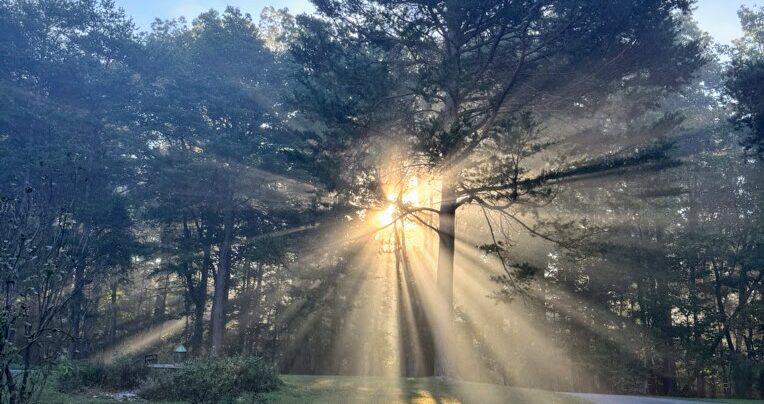
Darkness is beautiful and necessary, but the light of the sun is essential, too. It is the source of the energy that powers our bodies and those of all other living things. Since we human beings aren’t able to use the sun’s energy directly, we must obtain it either from the plants that convert solar energy through photosynthesis, or by eating animals that have eaten plants, or both.
Photo by Kate Glick
Sunlight warms us, too, when we burn wood. It powers our furnaces and cars, when we burn the gas which once was the bodies of prehistoric animals who, one way or another, like humans, ate the sunlight captured by plants.
However we consume the sun’s energy, our bodies are powered by sunlight. The sun radiates light generously and freely. I am always astonished when I consider how it gives itself away without ceasing, nurturing us and all living things on planet Earth.
For all of this, as I wait in the darkness of this longest night, I give thanks.
I knew early in my acquaintance with Pendle Hill that I wanted to be a resident student someday. After years attending conferences and other events, I was joyful when the time finally came.
My two ten-week terms as a resident student provided the time, space, and loving community in which a great deal of healing happened, emotional and relational as well as spiritual. At Pendle Hill, the rhythm of life itself creates conditions for transformation. Daily morning worship, shared meals, manual work, classes, and unstructured time all conspire to soften the armor we’ve built around our hearts. The transformation I experienced arose naturally from being held in a community that lived, worked, studied, struggled, celebrated, and played togethe, a community where it was possible to be a deeply serious spiritual seeker, and at the same time a place to find companions with whom to to be silly, laugh together, and explore untapped modes of creative expression. When you wash dishes alongside someone who has just listened deeply to you in class, when you laugh over dinner with people who know your struggles and hopes, when you share your dreams and then sit in silence morning after morning with companions on the journey, deep healing happens. Not because anyone is trying to fix you, but because you’re finally in a place where you can be yourself, where the power in you can emerge more fully, bit by bit.
Daily Spiritual Practice in Community
Daily meeting for worship provided a rhythm of spiritual practice that anchored everything else. We gathered in silence, waiting, listening, opening ourselves to the Spirit’s movement. Consistent, communal spiritual practice is transformative in ways that solitary practice, however faithful, cannot fully replicate. Today you can join Pendle Hill’s morning worship online. That is a wonderful spiritual practice; but something richer often happens when you are together in in the body, in the community.
In the gathered silence, you learn to trust the group’s capacity to hold difficult emotions and profound insights. You discover that divine guidance doesn’t just come to individuals but moves through communities who listen deeply together day after day. The boundaries between “spiritual life” and “ordinary life” soften.
Deep Conversations and Freedom to Follow What Calls
Everything becomes potentially sacred: the conversations over breakfast, the conflict that arises while working together, the tears during class when you reveal a hidden truth, the laughter that erupts at an evening event. Someone down the hall is likely to become a special confidant, while someone else may feel a bit annoying. Getting out of our familiar environment and patterns, among new companions, provides an opportunity to gain fresh perspectives on our lives and to see more clearly what might need to change. Moments of friction or irritation show us things in ourselves that can be very helpful if we lift them up to the light for insight and transformation. Spending extended time in community teaches that we can love and feel compassion for even people we sometimes find annoying, and also for ourselves.
A spiritual field is created that helps everybody who participates become more aware of their inner life and the working of the Spirit in them and others. This invisible spiritual field facilitates profound healing on many levels. Knots in the psyche become untangled and the voice of the soul is heard more steadily. Sometimes physical strengthening happens, too.
The community of last year’s Spring Term resident program included several people who hold important ministerial positions in their respective denominations and congregations; they were taking sabbatical time at Pendle Hill. They shared and explored new spiritual practices, often during the evening epilogue. At meals and in classes and seminars, they engaged in lively theological dialogue and shared about their faith journeys. As the weeks passed, they were also increasingly able to relax, let their hair down, and reveal silliness or little quirks. At an informal evening sing-along event, one demonstrated a children’s song from their country that included a bunny hop, and one minister danced in such a way that another one wondered if she had been drinking “new wine.” And everybody’s hearts got a little softer.
Life in the Pendle Hill community offers a space for inner exploration that is hardly possible in any other context of ordinary life. Deep conversations happen not just in formal classes but over meals, during work assignments, in chance encounters in a hallway. When everyone around is engaged in their own spiritual search and when vulnerability is met with compassion rather than judgment, we find ourselves able to explore territories that usually remain hidden.
I came to Pendle Hill with certain questions and plans, but the supportive context of community life opened space for something else to emerge, something truer, more urgent, more alive. The project I had planned to work on was not the one I completed. While I was at Pendle Hill, the opportunity and supportive context arose for a different project, my pamphlet Holding One Another in the Light, which engaged my heart and mind in ways I hadn’t anticipated. I wasn’t just writing about holding one another in the Light; I was experiencing it, daily, in worship, work, and relationship.
This is one of the most precious gifts of the resident student program: the freedom to follow what’s actually calling you, rather than what you think should be calling you. Pendle Hill gives you permission to change direction, to let go of old plans, to trust what’s emerging. There are teachers and companions to help you discern what’s truly yours to do.
A Container for Discernment
For those who are searching their hearts to discover how they are led to make their best contribution to this world in such need, Pendle Hill offers an unparalleled container for discernment. The program doesn’t tell you what your calling is. Instead, it creates conditions in which you can hear more clearly what God is already speaking within you. It provides:
Silence to listen beneath the noise of external and internal expectations
Community to reflect back to you what they see and sense in you
Companions who ask questions that open rather than close possibilities
Practices that help you distinguish ego’s voice and cultural conditioning from the leadings of the Spirit
Time to wait, to sit with uncertainty, to let clarity ripen
Support to take small steps toward what you’re being called to do
I have watched this discernment process unfold not only in my own life but in the lives of many other resident students. Many arrive at Pendle Hill confused, burned out, or uncertain about their next chapter in life. Over weeks and months, something shifts. People leave clearer, more grounded, more confident in their sense of calling, and happier just to be who they were.
Learning to Live in the Questions
Pendle Hill taught me that we don’t always need answers. Sometimes what we need most is to learn how to live faithfully in the questions, trusting that clarity will come in its own time. This is counter-cultural a world that demands certainty, productivity, and measurable outcomes.
The resident student program gives you time to sit with big questions: What am I called to do with my life? How do I heal from past wounds? What does God desire to do in and through me? How can I contribute to healing this broken world? What does it mean to live faithfully in this time of crisis?
You’re invited to arrive with questions and to trust that the community, the practices, and the rhythm of life at Pendle Hill will help you find your way. You may discover new questions or deeper questions that help guide you into the next phase of your life.
The resident student program at Pendle Hill is a place to step back for a time from the relentless demands of ordinary life and our troubled society, in order to ask the deeper questions. It’s a place to come into an updated sense of who you really are and what your soul has to give, so that you can serve more from wholeness than woundedness. It’s a place to discern your calling so that you can offer your unique gifts rather than just reacting to one crisis and then the next. It’s a place to find renewal, so that you have energy and hope for the journey ahead.
An Invitation
If you’re reading this and feeling a nudge in your heart, a sense that maybe this is for you, I encourage you to listen to that stirring. Taking time out to discern your path is important. Your clarity matters. Your unique contribution to the healing of the world is needed. Pendle Hill can support you in becoming more fully who you really are.
The 2026 Spring Term at Pendle Hill begins March 1. Enrollment is possible for either four or ten weeks. The registration deadline is Jan 1. For more information about the Resident Student Program at Pendle Hill, visit https://pendlehill.org/calendar/the-spring-term-resident-student-program/.
***** HERE is a link to a videorecording of a talk byEmily Savin about her experience in residence at Pendle Hill. Emily will be serving as Friend in Residence during the coming Spring Term. Teachers in residence this spring include Valerie Brown, Marcelle Martin, and Dwight Dunston.
Upcoming Online Webinar with Marcelle Martin:
Divine Guidance in Dreams and Images
December 12 @ 3:00 pm– 5:00 pmEST
A webinar with Spring Term teacher Marcelle Martin on how divine guidance and calls have appeared both in scripture and in the dreams of Quakers. Spirit often guides and communicates through dreams and inner images. They can be especially helpful in finding healing and a path forward in uncertain times. In this webinar, Marcelle Martin will illustrate how divine guidance and calls have appeared both in scripture and in the dreams of Quakers. We will experience some different methods of exploring our dreams (and inner images) to find the guidance they contain. There will be an opportunity to share in a small group and to witness a demonstration of working with a dream.
A Guide to Faithfulness Groups explains what faithfulness is and how it can be cultivated by small groups that practice ways to listen inwardly together for divine guidance, a practice that holds great potential for supporting individuals of any faith in allowing the work of the Spirit to become manifest through them and their communities.
Our Life is Love: The Quaker Spiritual Journey describes the transformational spiritual journey of the first Quakers, who were inwardly guided by God to work and witness for radical changes in their society. Focusing on ten elements of the spiritual journey, this book is a guide to a Spirit-filled life, designed to be a resource for both individuals and groups to explore their spiritual experiences. It describes the journey of faithfulness that leads people to actively engage in God’s work of making this world a better place for all. Our Life is Love has been reviewed by Marty Grundy in Friends Journal, by Carole Spencer in Quaker Religious Thought, and by Stuart Masters on A Quaker Stew.
Both books are available from Barclay Press in hardback and paperback.
Those who oppress the poor insult their Maker,but those wo are kind to the needy honor him. –Proverbs 14:31 (NRSV)
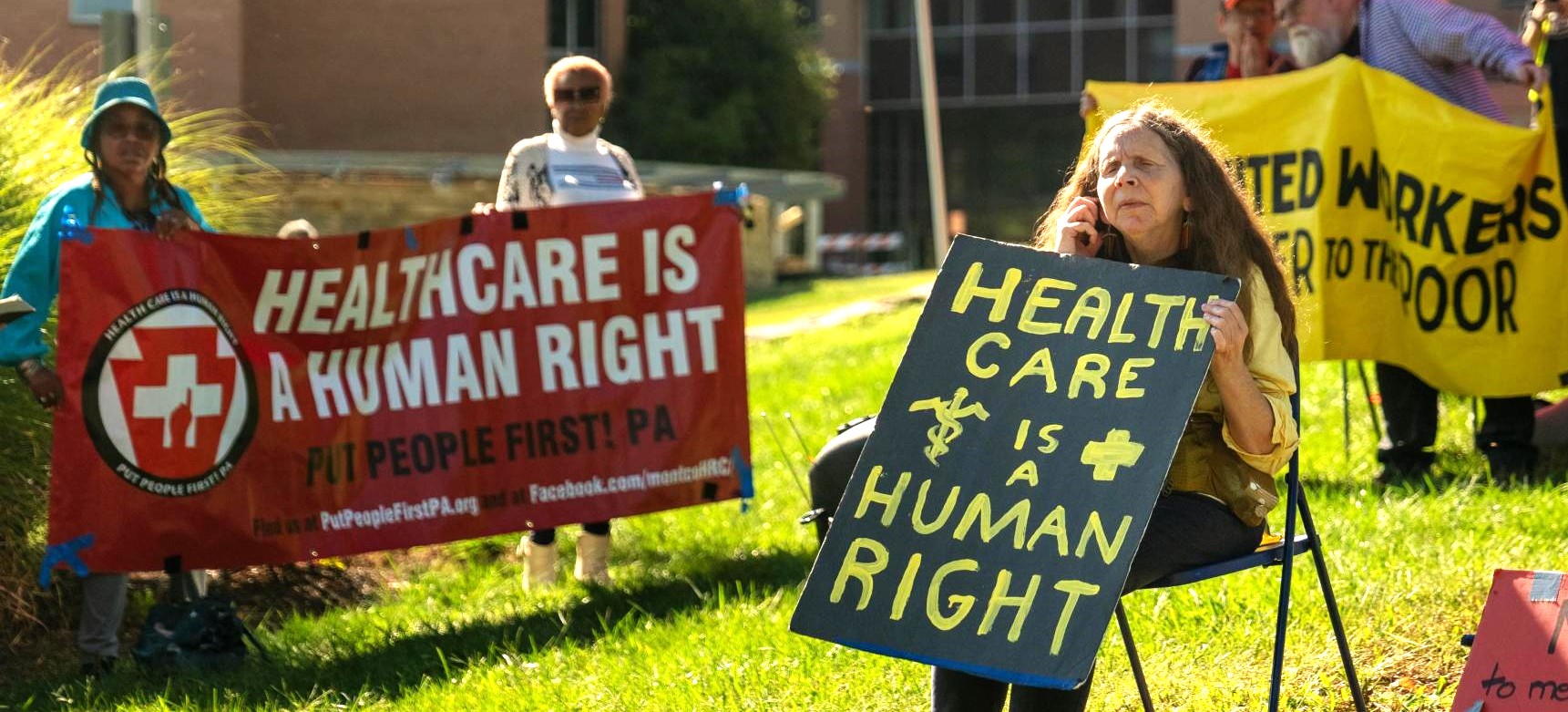
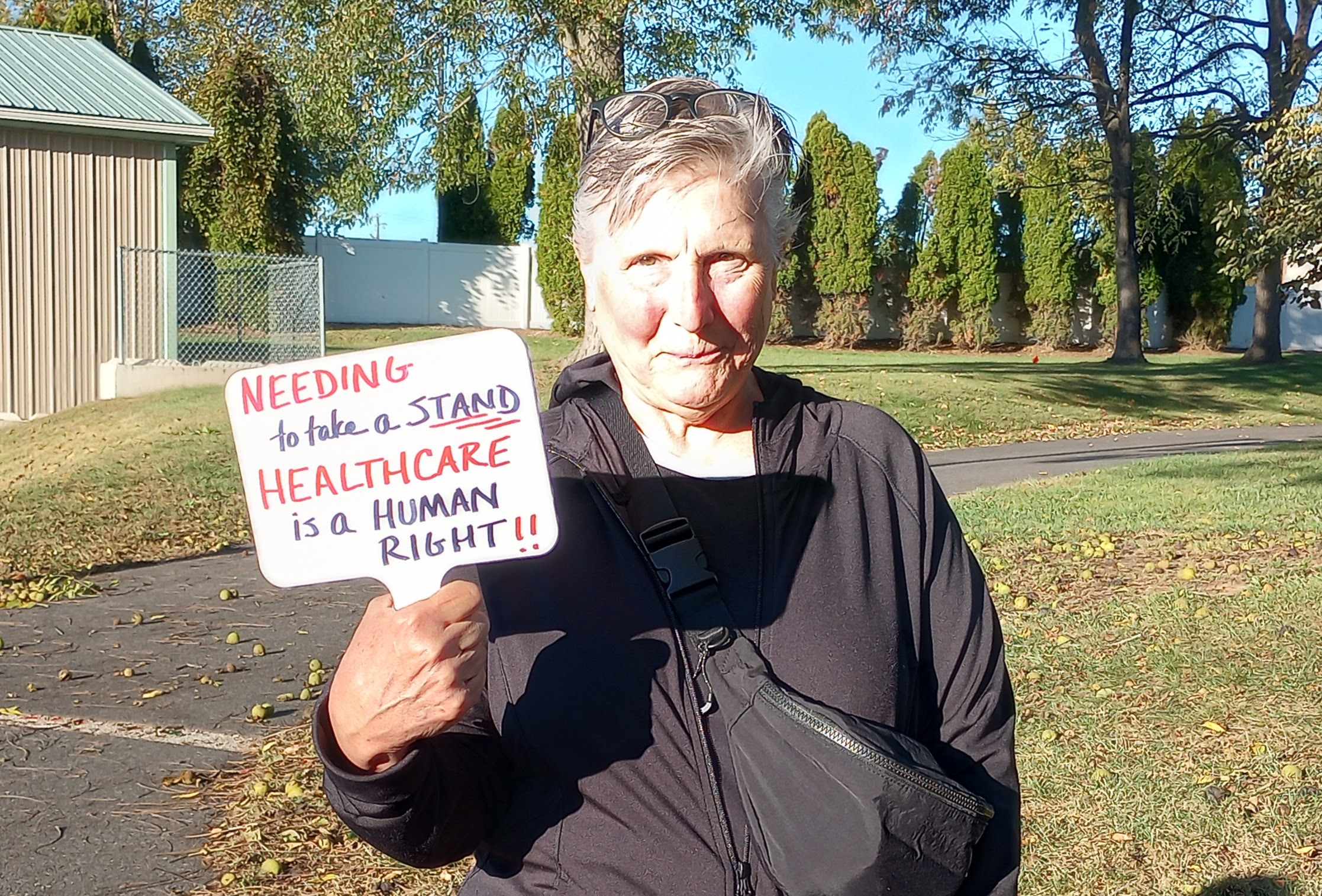
When a city loses its hospital, doctors, crisis center, and medical offices because of unchecked corporate greed, the need to heal our society becomes more clear. This morning I attended a preliminary court hearing for a group known as “The Crozer 8.” They had been arrested at a peaceful sit-in protesting the closing of Crozer-Chester Hospital and its medical offices, facilities that had been providing essential services to over half a million people. About 2,700 employees abruptly lost their jobs when the healthcare system closed in May 2025, including my primary care doctor, gynecologist, and another physician who had been treating me for an ongoing medical condition.
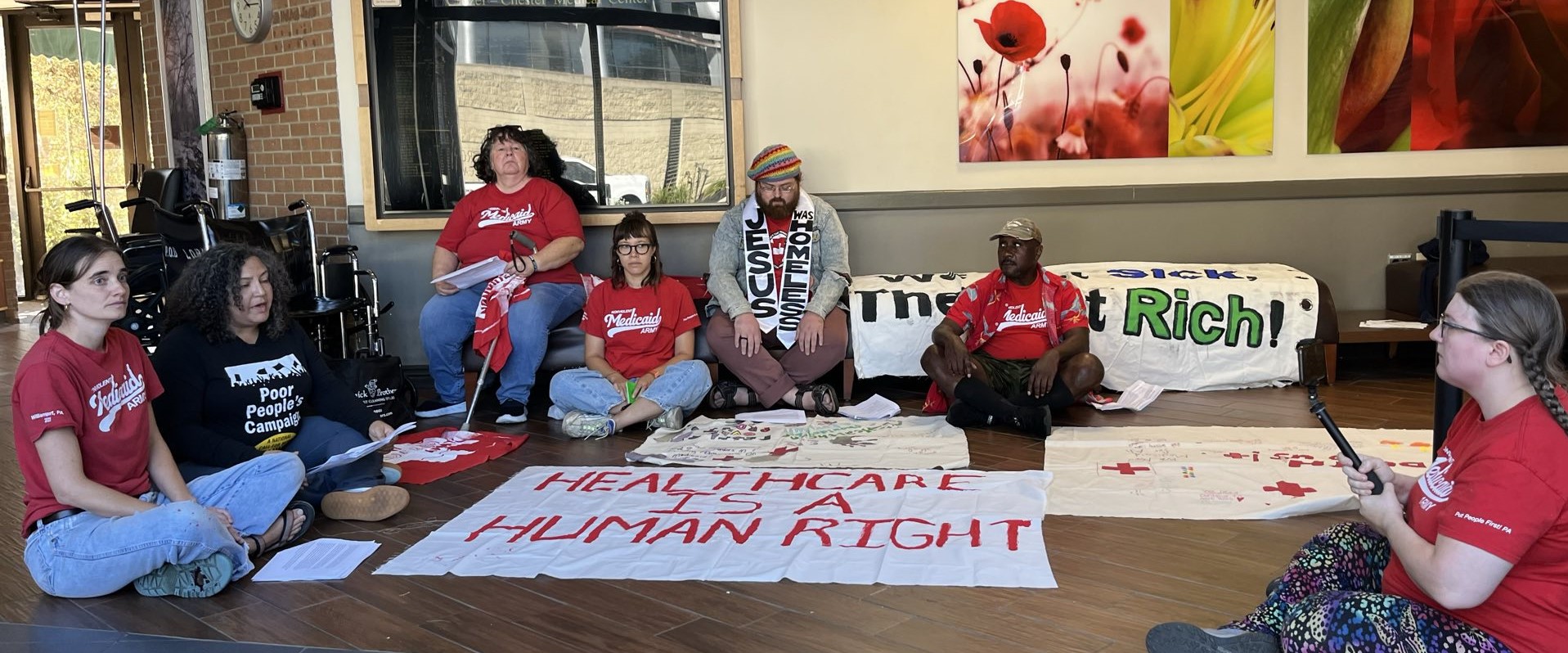
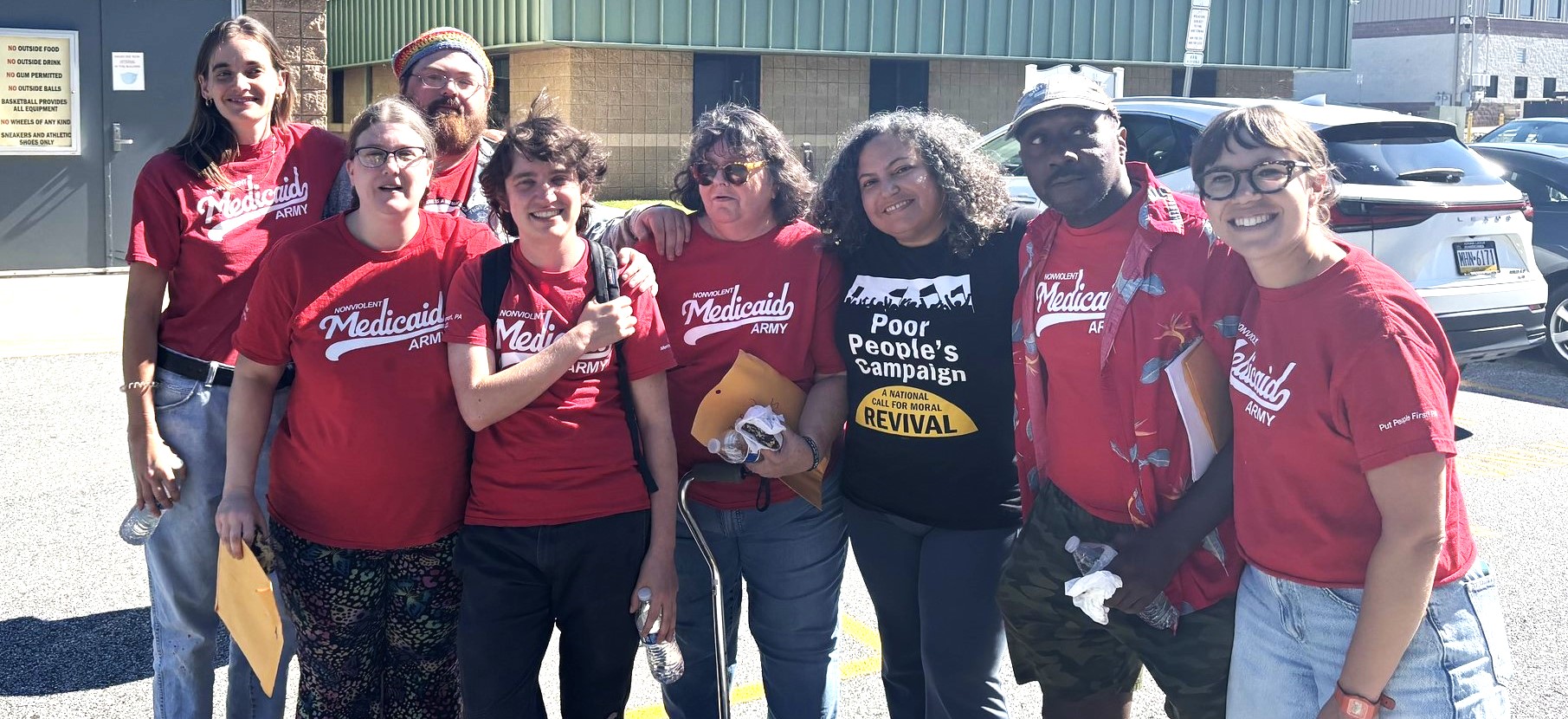
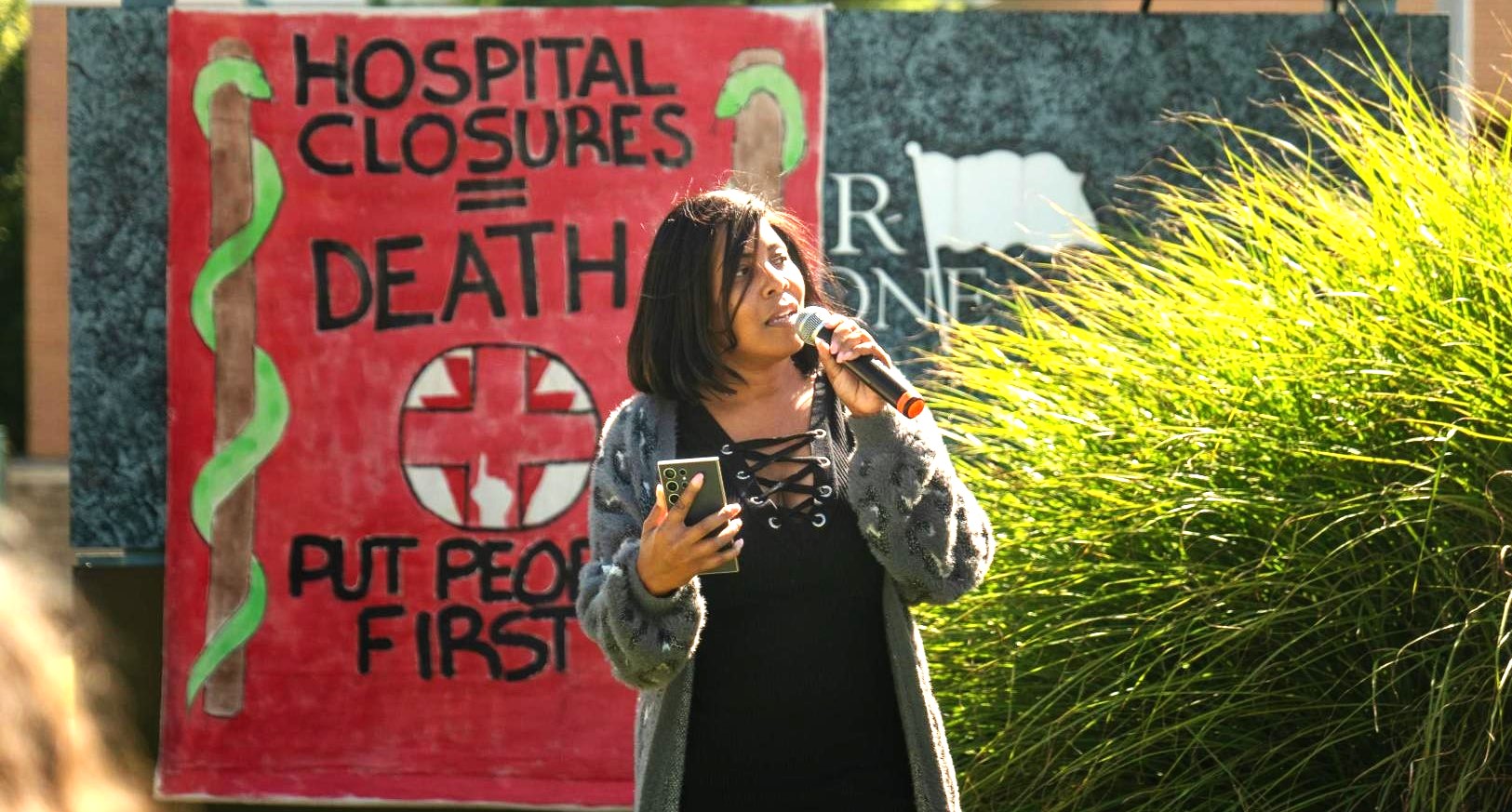
Who are the Crozer 8? On Monday, September 8, 2025, fifty people, including former workers and patients, held a rally in front of the closed Crozer-Chester Medical Center campus in Upland, PA. Eight of the protesters entered a medical office building within the complex that had not yet been completely shut down. They peacefully sat on one side of the lobby, taking care not to block foot traffic.
They declared:
“We are a group of people whose families have been hurt and harmed by this criminal healthcare system that puts profit over our lives. We’re sick and tired of getting sick while Wall Street gets rich, and we’re not going to take it anymore.”
In making the difficult decision to engage in nonviolent direct action and to risk arrest, they drew on the legacy of Rev. Dr. Martin Luther King Jr., who attended the nearby Crozer Seminary from 1948 to 1951. King had explained that breaking minor laws may sometimes be necessary to redress greater harm:
“There is nothing wrong with a traffic law which says you have to stop for a red light. But when a fire is raging, the fire truck goes right through that red light, and normal traffic had better get out of its way. Or, when a man is bleeding to death, the ambulance goes through those red lights at top speed. There is a fire raging now… Disinherited people all over the world are bleeding to death from deep social and economic wounds. They need brigades of ambulance drivers who will have to ignore the red lights of the present system until the emergency is solved.” (The Trumpet of Conscience)
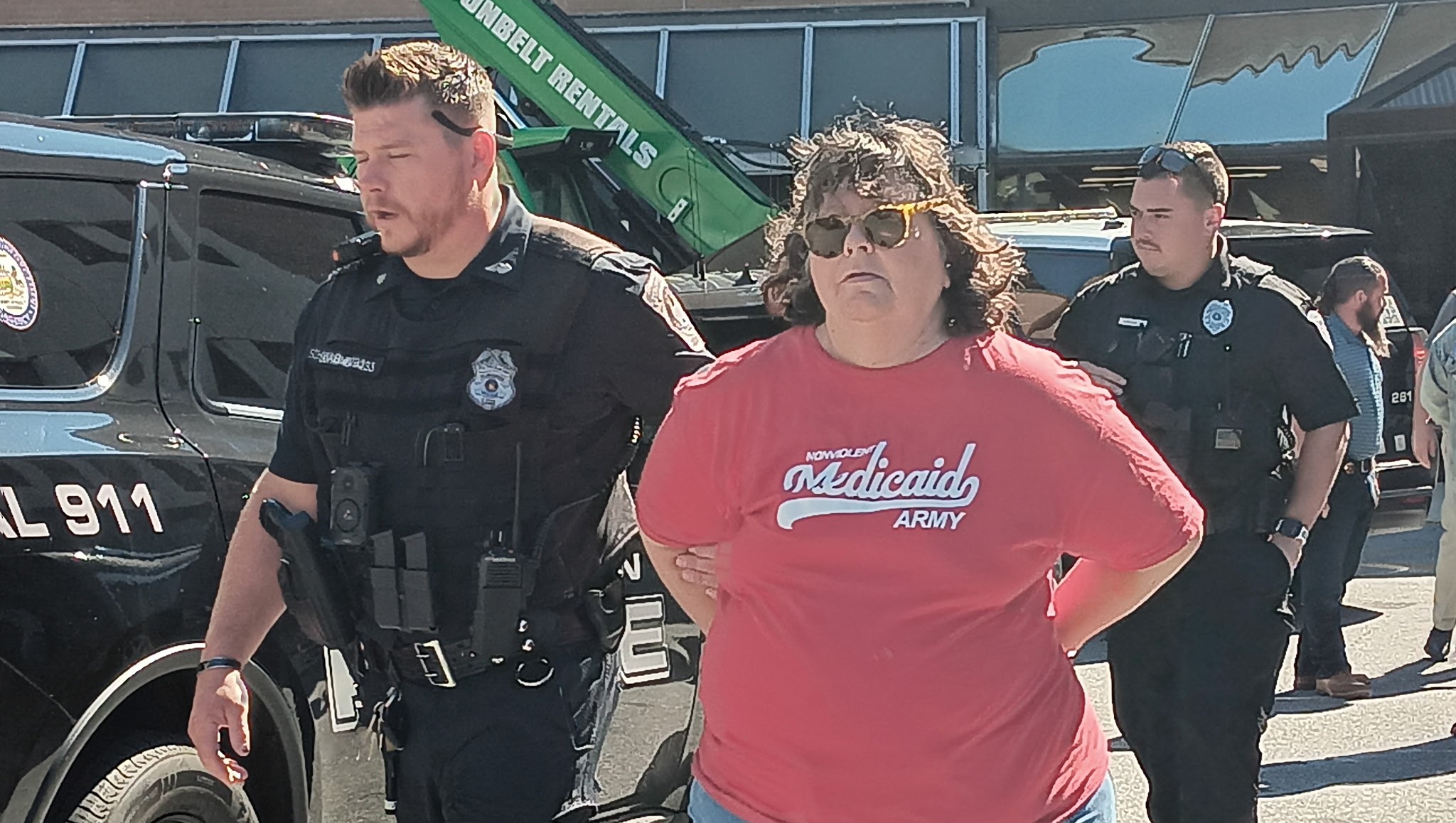
When ordered to leave by the police, the eight people who were participating in the peaceful sit-in refused to get up. They were arrested for “defiant trespassing.”
The protesters were members of at least two groups. One, Put People First! PA, a politically independent organization, had organized a “National Day of Action,” holding protests at four different sites across Pennsylvania where local residents have lost access to medical care because of corporate greed. The event held in our area, “Speak Out @ Crozer,” called on Delaware County to use eminent domain to reopen Crozer and to protest hospital closures caused by the corporate misuse of healthcare assets. Another group participating in the protest, the Nonviolent Medicaid Army (NVMA), is a national advocacy organization that organizes days of action focused on Medicaid, health access, and hospital closures. Both groups insist that healthcare is a fundamental human right.
Invited by a member of our Quaker Meeting, my husband and I attended the hearing today to show community support.We and our neighbors inChester have been left without a hospital in our city. Twenty-six hospitals have closed in Pennsylvania in the past five years. Over the past decade, more than 100 rural hospitals have shut down nationwide, and hundreds more are at risk. Like the Crozer 8, we, too, want new laws that will prevent corporations from siphoning healthcare assets for shareholder profit.
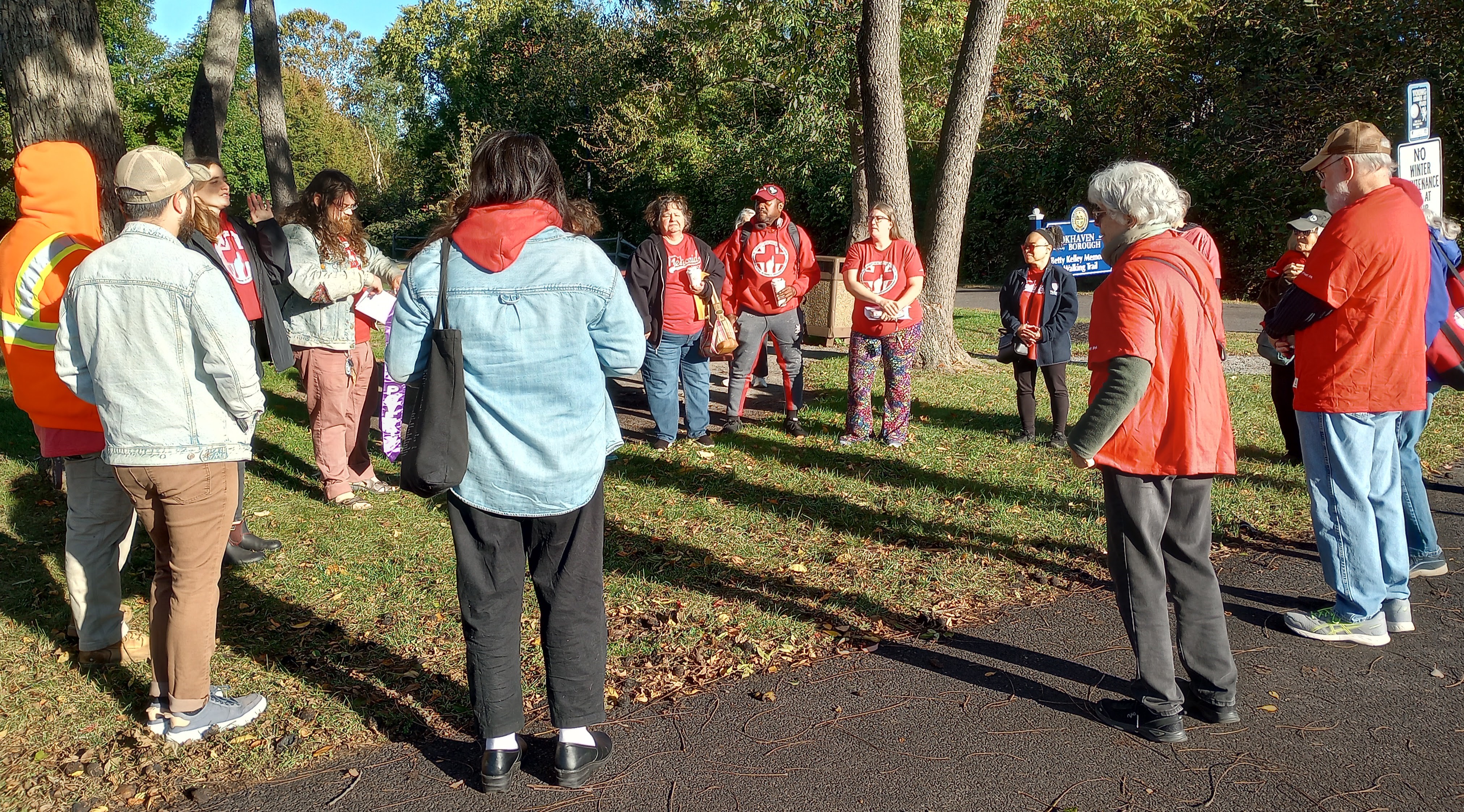
The Crozer 8 arrived this morning in red t-shirts, some half-hidden by jackets in the brisk autumn air. They offered donuts, coffee, and surplus t-shirts to supporters. Under trees near the courthouse, they conferred briefly with the lawyer representing all eight of them, then invited everyone to gather in a circle. Then each of the eight read a portion of a collective statement explaining their action and their hopes for just laws and healthcare for all. At the end, a minister among the Crozer 8 gave a short sermon, telling the story of the poor widow who pestered the unjust judge until he granted her justice (Luke 18:1–8). “We must do the same,” he urged. “We must take care of the needs of all.”
The minister taught a song, which we all sang together. As I joined my voice with theirs under the rustling trees, I felt the moral clarity of their action, the insistence that caring for one another is a basic act of justice.
One citizen, a young man who had stopped by on his way to work, told us that his life had been saved at Crozer-Chester when he was brought in with raging pneumonia. Another woman said her husband’s life had been saved there too, after a venomous spider bite that can be fatal. These two men might not have survived a longer ambulance ride.
The small courtroom was packed. Three police officers, two burly men and one woman dressed all in black, with firearms and other weapons strapped tightly to their bodies, stood beside the judge’s bench, talking casually while court staff prepared the room. Then, one by one, the eight defendants stood with their lawyer to address the judge. The judge handed them paperwork and instructed them to return to court in December.
In 2016, Prospect Medical Holdings, a private company, acquired the local Crozer-Keystone Health System in Delaware County, Pennsylvania, which included four hospitals. In the following years, Prospect systematically stripped the assets of those hospitals for the profit of its shareholders and officers. The company sold the hospital properties to a real estate investment trust and distributed $457 million of the proceeds as dividends to investors, while burdening the healthcare system with a massive mortgage debt of more than a billion dollars. Prospect also failed to pay $150 million in pensions owed to hospital employees. Weighed down by debt, the hospitals could not stay afloat. Prospect closed two of them. Then in May 2025, the company declared bankruptcy, causing the sudden closure of the remaining two hospitals. In addition to abandonning communities not bereft of essential care, the company left behind huge unpaid debts. (According to the Chester Water Authority, Crozer-Chester Hospital, under Prospect’s management, left $1.7 million in unpaid water bills, a loss which now will be passed on to local residents through higher water rates.)
Since the closing of Crozer-Chester Hospital, the nearest remaining hospitals in our area, especially their emergency rooms, have been terribly crowded, sometimes with waits of nine hours before people in medical crisis can be seen. This summer, I attended a meeting of concerned neighbors. Among the speakers was a doctor who had worked in Crozer-Chester’s ER. He told us that since the closure, some patients who could have received life-saving care at Crozer died while taking a longer ambulance ride to another hospital.
After I suddenly lost access to all three of my local doctors, I became more aware that this kind of corporate looting of healthcare assets is taking place all over the country, a moral crisis affecting rural and low-income communities across the United States, irrespective of local politics. The for-profit corporation that owned Crozer-Keystone extracted millions of dollars from the four-hospital system, diverting funds meant for patient care into private profit. This was a choice made in boardrooms far from the people now suffering the consequences. This injustice reveals how easily human need can be overshadowed by greed.
The Biblical prophets warned that a society can only flourish if it takes care of those in need: the oppressed, the orphan, the widow, and the poor. A society that loses its moral compass will crumble. When explaining the destruction of the city of Sodom, Ezekiel said, “This was the guilt of your sister Sodom; she and her daughters had pride, excess of food, and prosperous ease, but did not aid the poor and needy.” Ezekiel 16:49 (NRSV)
Healthcare is not a luxury, not a commodity like shoes, smartphones, or new kitchen cabinets. It is part of the web of care that sustains life and holds communities together. When that care is stolen to profit a few, it tears at the moral fabric of society. When human lives are endangered so that shareholders may receive another dividend, when hospitals are left standing empty and sold off, sometimes to be rebuilt as luxury housing, we are witnessing the unraveling of our social fabric. The loss of Crozer is not just a local tragedy; it is a symptom of a national illness, showing what happens when the hunger for profit is allowed to eclipse compassion.
Like the persistent widow, the Crozer 8 continue to demand that compassion and justice be restored to the heart of our public life.
The Crozer 8 are raising funds to help pay their fines and other court costs. Their fiscal sponsor is United Workers, Inc. If you are moved to read more about their witness and maybe to donate some funds, go HERE.
When the Healers are Sent Away, the Prophets Must Rise: When have you taken a stand for justice, peace, compassion, sustainability, or what is right and true?
A Guide to Faithfulness Groups explains what faithfulness is and how it can be cultivated by small groups that practice ways to listen inwardly together for divine guidance, a practice that holds great potential for supporting individuals of any faith in allowing the work of the Spirit to become manifest through them and their communities.
Our Life is Love: The Quaker Spiritual Journey describes the transformational spiritual journey of the first Quakers, who were inwardly guided by God to work and witness for radical changes in their society. Focusing on ten elements of the spiritual journey, this book is a guide to a Spirit-filled life, designed to be a resource for both individuals and groups to explore their spiritual experiences. It describes the journey of faithfulness that leads people to actively engage in God’s work of making this world a better place for all. Our Life is Love has been reviewed by Marty Grundy in Friends Journal, by Carole Spencer in Quaker Religious Thought, and by Stuart Masters on A Quaker Stew.
Both books are available from Barclay Press in hardback and paperback.
Many years ago I was silently beckoned by a beautiful wide-armed American Elm in the park close to my home. I responded, drawing close and leaning my back against the trunk. A relationship began that has taught me a great deal—about trees, about myself, about life. I wrote a blog post, Beckoned By Trees, about that story. The connection has continued, now with both that tree and “her” partner nearby.
My almost-daily walks in Chester park have helped me feel a connection to the land on which I live. I love the open spaces in the park, the many flowering ornamental trees, and the river birches. Increasingly, however, I am drawn to the tall oak trees. If I walk far enough—down to the creek, over the stone bridge, and up the hill on the other side—I come to an area that contains little remnants of the original oak forest that once covered this part of Pennsylvania.
As I wind up the road on the other side of the creek, I come to clusters of enormously tall oaks that have been standing together for well over a century. In my gut I feel drawn to be with these trees, sensing both their rootedness and their great height. I am not called to be in a “relationship” with them, such as I have formed with the beautiful elm close to my home, but simply to be present in their presence.
Being with these clusters of tall old oaks has a grounding effect on me, which I feel not only in my feet but also in my belly, a greater solidity. In their presence I stand up straighter and feel my own height. In spite of the adjacent dirt parking areas littered with debris, I find a place to sit, usually on a log, or on the ground. I breathe silently and just commune with the trees and the rest of the natural world. These trees do not feel like individuals, but more like a collective, and in their company I, too, feel less like an individual. Among them, I am absorbed by a larger presence.
Sitting one morning recently, my back close to the trunk of the largest oak in the cluster, looking at the dirt, sticks, and small green plants around me, I felt my belonging.
“I am part of the earth,” I thought.
Then I was reminded about all that I had learned about belonging to the earth from Joanna Macy. I felt moved to go home and write a blog post about her amazing life and teachings. I did so, feeling that the trees had sent me to do it.
More recently, I was drawn farther up the road, to the largest remnant of forest left in the park, then into the woods and downhill to sit next to the tallest oak on the bank of a small creek. I could hear cars traveling not far away, but nonetheless there was a sense of hush and privacy in those woods. I rested beside the roots of the tree for a long time, my mind quiet, absorbed by the feeling of presence. It was something like being in a meeting for worship—not only with the trees, but also the earth, the plants, the rocks, and the flowing creek. My separateness dissipated and I came into unity.
This has happened before when I’ve spent time quietly in the woods, but now there is a stronger feeling of attraction to be with the clusters of old trees and woods, a greater pull, a sense of some separateness being peeled off of me. In this chaotic and frightening time—politically, socially, economically—in a world in which climate change is accelerating and feels out of control, my nervous system is distressed and the need for stability is greater than ever. I’m so glad for my husband, friends, family, neighbors, spiritual community, and the collective of sensitive, caring people around the world, all of which helps me feel stable and supported. But other people do not fully provide the kind of greater belonging which is needed now, which the earth itself provides, if we are open to it. Which the starry cosmos provides, if we are aware of it. Which the divine light that flows through all things gives. All of it part of the great wholeness that is God.
Right now, the trees, woods, and earth itself together are a critical doorway for me to the greater realms of wholeness. They have sent me home to write this blog post for you to read, inviting you, too, to make time to rest in their wise and grounded presence.
To locate an old growth forest near you, go to the Old-Growth Forest Network, “the only national network in the U.S. of protected, old-growth, native forests where people of all generations can experience biodiversity and the beauty of nature.” Their goal is “to locate and designate at least one protected forest in every county in the United States that can sustain a native forest. We estimate that to be approximately 2,370 out of 3,140 total counties. To achieve this aim we work to identify forests for the Network, ensure their protection, and inform people of the forest locations. We are building not only a network of forests, but also an alliance of people who care about forests.” https://www.oldgrowthforest.net/.
At the age of 96, Joanna Macy, a great soul, left this world, having served as a guide and teacher for many. I was fortunate to attend a one-day workshop with her years ago at a Quaker center in Philadelphia, but I knew her mostly from books and videos, and from experiences shaped by her philosophy, called The Work That Reconnects.
Macy’s beautiful memoir, Widening Circles, begins with trees. On her grandparents’ farm there was a tree out back in which she and her brother played wild games. And in the front yard was a tall maple in which she would sit alone, in silence, hidden by leaves but present to the world.
In college Macy had prepared for a vocation in Christian ministry, but immersion in the intellectual debates of the early church fathers caused her to leave that path. Her husband worked for the Peace Corps and while they were stationed in India in 1965, Macy came in contact with the Tibetan Buddhist refugees who lived there. They and their teachings made a big impact on her and she became seriously engaged with Buddhism.
The Macys raised three children and lived for years in Africa as well as India. Around 1969 they moved to New York, so that Joanna could study world religions at the University of Syracuse. There she encountered systems theory, which is based on the premise that the universe is not made up of separate objects, but a network of interconnected systems. She wept while reading Ervin Laszlo’s Introduction to Systems Philosophy, because it resonated so deeply with a “whole-body knowing” she felt inside, as though she already possessed the insights and principles he described. She decided to focus her Ph.D. thesis on mutual causation, combining Buddhist thought and systems theory.
After reading a paper written by her son about the thermal pollution caused by nuclear power plants, she participated in protests against the Seabrook reactor in New Hampshire and other nuclear power plants. Then she became aware of the long-term radioactive contamination caused by both nuclear power and weapons production and was horrified to realize that radioactive waste will affect future generations, possibly for thousands or millions of years. Understanding that these consequences stretched into geological time, she turned her attention to the concept of nuclear guardianship, which emphasizes community responsibility for the monitoring of radioactive waste, rather than simply burying it and forgetting about it. However, she found widespread apathy about the dangers of nuclear energy.
Macy saw that disconnection from the earth and from our deep emotions are causes of humanity’s collective inaction about existential threats. She recognized that power for action can be released by allowing ourselves to feel our love for the world, as well as our grief and despair for the harm being done to the web on life. She wrote that suffering with our world, “enables us to recognize our profound interconnectedness with all beings. Don’t ever apologize for crying for the trees burning in the Amazon or over the waters polluted from mines in the Rockies. Don’t apologize for the sorrow, grief, and rage you feel. It is a measure of your humanity and your maturity. It is a measure of your open heart, and as your heart breaks open there will be room for the world to heal. That is what is happening as we see people honestly confronting the sorrows of our time.” In 1978 Macy began offering “despair and empowerment workshops.” Some of the first were offered in Quaker settings.
Methods and rituals were developed in Macy’s workshops, and a training developed that was eventually called “The Work That Reconnects.” Macy’s 1998 guidebook, Coming Back to Life, co-authored with Molly Brown, provides a comprehensive explanation of it and describes a multitude of group practices that were helpful. Victoria Loorz, author of Church of the Wild, writes that Macy’s work revealed that “real, lasting action must be rooted not in urgency or fear, but in fierce, devotional love—the kind that grieves fully and acts anyway.” Workshops on The Work That Reconnects have been offered at both Pendle Hill and Ben Lomond retreat centers, and today several Quakers travel to lead workshops related to Macy’s work. Quaker Environmental Witness (QEW) helps meetings find facilitators.
Macy’s teaching has had a significant impact on me. In 2007 I was part of the teams that created the nine-month Way of Ministry program at Pendle Hill and then the three offerings of the Nurturing Faithfulness program in New England Yearly Meeting, starting in 2017. When we wanted to find experiential ways to help participants open up to the embodied and emotional work that is an essential part of awakening to prophetic ministry, we adapted some of the practices Macy and her colleagues had developed. For many participants of The Way of Ministry and Nurturing Faithfulness, these embodied group experiences, involving the big emotions connected to love of the world, fear, anger, and grief, were helpful and even transforming.
In 1985, Joanna Macy and John Seed, inspired by indigenous wisdom, developed the Council of All Beings, a communal practice to help individuals transcend their human-centered perspective and connect more deeply with the rest of the world. Some participants choose to represent a particular kind of animal, plant, or element of the ecosystem (such as a river) and in a circle speak on its behalf, sharing their experiences, challenges, and how human behaviors have impacted them. The non-human beings also offer their wisdom, providing insight into possible ways forward. Some in the Circle remain in their human identity, listening to the perspectives of the others. The experience cultivates a deeper sense of interconnectedness, inspiring participants to take action on behalf of the Earth.
We are living in a time Macy called the Great Unraveling. Our extractive global economy is destroying the earth’s ecosystems. She holds out hope that we are heading into The Great Turning, a long-term movement toward a sustainable way of living embedded harmoniously in the web of life. The Great Turning requires a multitude of efforts. She names three necessary roles. 1) Resisting and protesting the harms being done and minimizing them as much as possible. 2) Building new systems and relationships, and creating sustainable ways of life for the future. 3) Working to change consciousness and values. Macy’s life work supported all three kinds of efforts.
Her book Active Hope: How to Face the Mess We’re in with Unexpected Resilience and Creative Power, written with Chris Johnstone, “serves as a trustworthy guide to these perilous times,” writes Pamela Haines in a Friends Journal book review of the 2022 revision. According to Haines, the book invites readers to see life as an adventure story in which we are the main characters:
“protagonists always face obstacles that seem overwhelming but, nevertheless, set off to discover the allies, tools, and wisdom that will help them succeed. What if this is the essential adventure of our time, and we are its protagonists? We are propelled forward not just by information about problems and solutions, nor by our fears alone, but by a deeply rooted sense of connection: the essence of our very identity as part of the web of life is under attack, and our vision of what it means to be alive and whole is too palpable and compelling to ignore.”
Joanna Macy found encouragement in a Buddhist prophesy from twelve centuries ago, about a time when humanity would face a terrible crisis and great danger. The Shambhala warriors, who were ordinary people, would take action everywhere, in the center of the danger, and meet the challenges from within. Their “weapons” would be compassion and wisdom.
We don’t know how or whether the challenges and dangers of our time will be met. Will we bring forth a Great Turning to a sustainable way of life? Will human beings collectively learn how to live again in harmony with the world that is our home? In order to act, we don’t have to know how it will turn out. We can be grateful for the breath we are breathing right now and for the gift of being alive. Then we offer our gifts, our love, our efforts, and join together in the collective adventure.
Joanna Macy: Living For the Sake of the World: What helps you experience your belonging to the world and your interconnectedness with the web of life? What inspires you to offer your gifts to the world?
Pendle Hill’s 95th Anniversary Gathering On Campus & Online: Sep 26-28, 2025 Come together for a weekend to connect, renew, and imagine together in community as we celebrate our 95th Anniversary. On Saturday Valerie Brown and Marcelle Martin will lead a workshop on Spiritual Discernment, an opportunity to seek clarity and spiritual guidance, with help from others. This retreat will be an opportunity to share in the Pendle Hill rhythm of meals, worship, singing, and learning together. Leaders of the 2025 resident student program and other special guests will invite participants into a weekend taster of our residential community. If you’re unavailable to participate in the full weekend, join us on Saturday evening for an on-campus Open House & Evening Celebration, or tune in online that afternoon to hear about History & Visions of the Future.
The 2026 Spring Term On Campus: Mar 1—May 4, 2026 Now accepting applications! Center down in the 2026 Resident Student Program, to settle into the daily rhythm of study, work, and worship in community on 24 beautiful acres outside of Philadelphia. Join us for Session I, Sessions I&II, or stay for The Quaker Institute. March 1 – March 28: Session I – Rest & Discern with Valerie Brown and Marcelle Martin March 29 – April 30: Session II – Practice in Community May 1 – 4: The Quaker Institute – Sing a New Song
A Guide to Faithfulness Groups explains what faithfulness is and how it can be cultivated by small groups that practice ways to listen inwardly together for divine guidance, a practice that holds great potential for supporting individuals of any faith in allowing the work of the Spirit to become manifest through them and their communities.
Our Life is Love: The Quaker Spiritual Journey describes the transformational spiritual journey of the first Quakers, who were inwardly guided by God to work and witness for radical changes in their society. Focusing on ten elements of the spiritual journey, this book is a guide to a Spirit-filled life, designed to be a resource for both individuals and groups to explore their spiritual experiences. It describes the journey of faithfulness that leads people to actively engage in God’s work of making this world a better place for all. Our Life is Love has been reviewed by Marty Grundy in Friends Journal, by Carole Spencer in Quaker Religious Thought, and by Stuart Masters on A Quaker Stew.
Both books are available from Barclay Press in hardback and paperback.
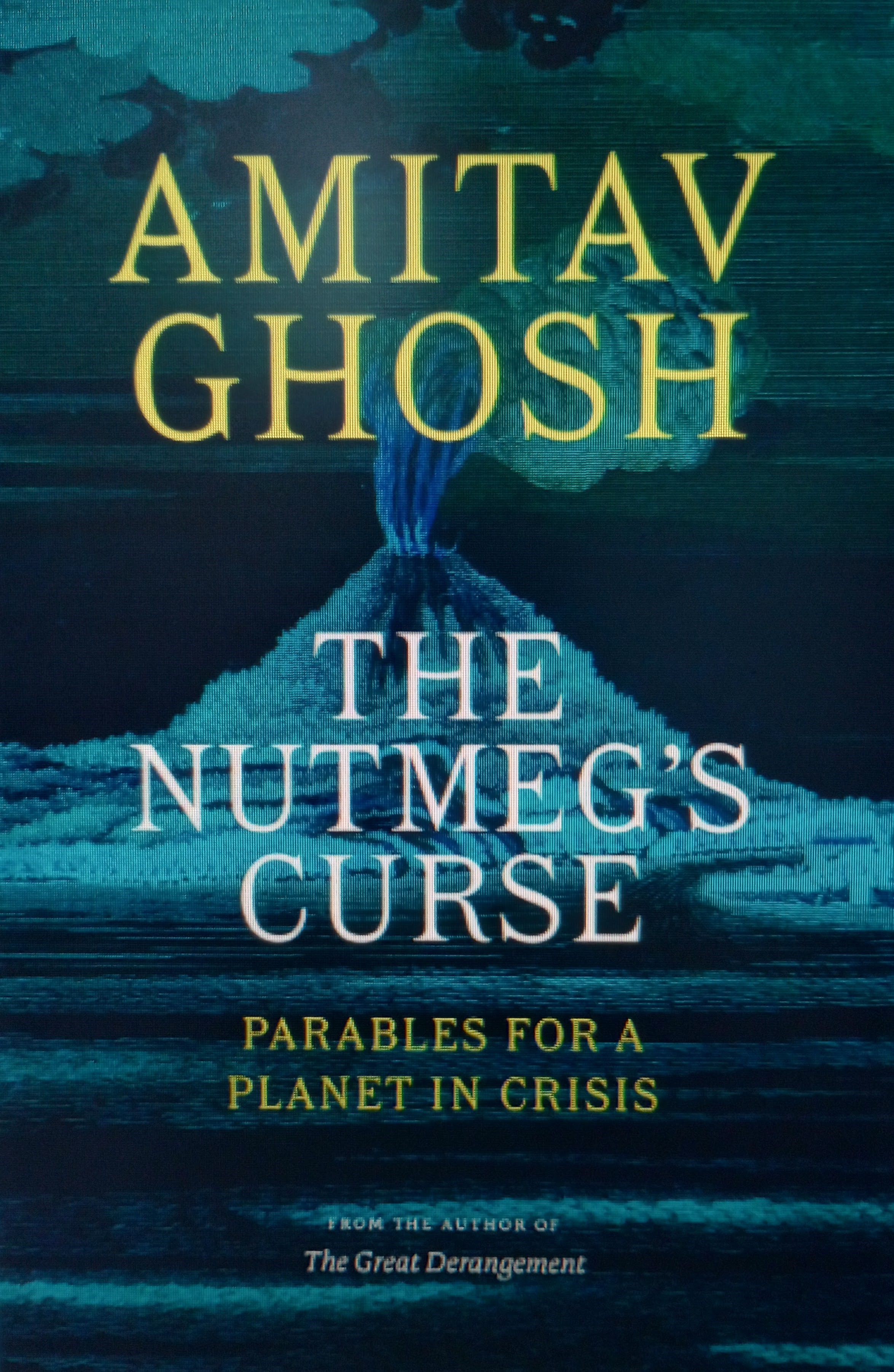
In Laudato Si, Pope Francis called for an urgent re-examination of how we care for our home, the Earth. In The Nutmeg’s Curse, award-winning Indian-born author Amitav Ghosh continues the conversation about what is needed to address the growing climate catastrophe. His book asks us to see the roots of the crisis going back several centuries. He brings readers in immediately with a gripping account of the 1621 Dutch takeover of the small Banda Islands in Indonesia. In the seventeenth century, the Dutch East India Company was determined to secure control over the world’s source of nutmeg, which originated on those islands. A prized spice, nutmeg was considered an exceedingly valuable commodity in Europe in that era, and the Dutch East India Company wanted to maximize their profits from it by creating a monopoly on nutmeg production.
However, the native people of the Banda islands resisted efforts to be colonized. During a night when tensions on the island were high, the Dutch captain in charge of a company of soldiers was startled by a lamp falling in the room where he was sleeping. When the lamp smashed on the floor and woke him up, he was convinced there was a conspiracy and ordered his soldiers to shoot into the dark. Soon he ordered a brutal massacre of the island’s leaders. Subsequently, the Dutch expelled or exterminated most of the native population, retaining only enough of the local people, now enslaved, to continue the cultivation of the nutmeg trees. Other enslaved people were brought in to help with the work. This event in 1621 set a model for subsequent colonial takeovers by Western European nations on continents all over the world. The Nutmeg’s Curse describes the shaping and spread of the extractive, colonial mindset that has caused great global destruction.
Ghosh argues that the climate crisis is not only a product of burning fossil fuels or industrialization, but the culmination of centuries of conquest, in which the colonial powers treated both people and land as resources to be exploited. In order to justify their behavior, he writes, European intellectuals first had to persuade themselves and then others that the earth was dead and that non-Europeans were not fully human. Ranging over continents and centuries, Ghosh shows how carrying out the violent suppression of people and destruction of ecosystems that was supported by this worldview has led incrementally to the ecological collapse now underway across the Earth.
Subtitled Parables for a Planet in Crisis, Ghosh’s book describes the conquests of numerous particular Indigenous peoples and their cultures, and details how European colonists “terraformed” the landscapes they dominated, in an effort to use them like the lands which which they were familiar. The stories in this book reveal that for centuries Europeans and their descendants have lived under the spell of a worldview that sees land as “property” and nature as “resources,” whose only purpose is human use. This approach to the Earth has been accompanied by an insistence upon a supposed superiority of white Europeans that denies the full humanity of others, especially of Indigenous and Black people. This worldview has not only shaped economies and governments, but fundamentally colonized imaginations and the capacity for sensitivity to the intelligent, living quality of the natural world.
What resonates most strongly from my reading of The Nutmeg’s Curse is Ghosh’s insistence in the final chapters that the Earth is active and alive. He reminds readers of older ways of being in relationship with the planet, of Indigenous peoples who have known the forests, rivers, mountains, winds, and all creatures to be full participants in the living world. In their various ways, Indigenous peoples everywhere have seen the Earth as a living presence with power and agency. Ghosh suggests that this power and agency, though oppressed, ignored, and hidden, is still active. In fact, it is fighting back.
The Nutmeg’s Curse tells more than the story of domination and spreading destruction. It is also an evocative invitation to reconnect with the natural world and to learn from the peoples who still can sense and communicate with the living qualities of the Earth. Ghosh names a few spokespeople for Indigenous traditions who have taught how the Earth is alive, full of spirit. He tells stories of communities and movements that have resisted domination and carried forward relationships with the land based on reverence, mutuality, and care. He gives examples of healthy cultures that have embraced diverse religions and ethnicities and centered themselves on a shared connection to the land and commitment to protect it.
The Nutmeg’s Curse is, at heart, a call to unlearn the colonists’ false story of separation; it’s an appeal to return to the deeper truth that we belong to the Earth and can only thrive if we come together with love and respect for the living intelligence of the planet and the interdependence of all its creatures. In order to participate in planetary healing, we will need to do more than reduce the burning of fossil fuels, cease destroying ecosystems, and find technological solutions. What is needed even more fundamentally is a profound awakening of sensitivity to realms of reality to which Western culture has been deadened for many centuries.
Caring for the earth is fundamentally a spiritual issue, as Indigenous cultures have always known. In 2015 Pope Frances directed world-wide attention to this in his second encyclical letter, “Laudato Si: On Care for Our Common Home,” in which he wrote that, “The universe unfolds in God, who fills it completely. Hence, there is a mystical meaning to be found in a leaf, in a mountain trail, in a dewdrop, in a poor person’s face. Standing awestruck before a mountain, we cannot separate this experience from God.” (233). In the encyclical he addressed environmental degradation and climate change, highlighting the connection between social justice and the environment, and urgently appealing for radical action in support of seven goals, including ecological economics, adopting sustainable lifestyles, community resilience and empowerment, ecological education, and ecological spirituality. Ghosh writes that, “Pope Francis speaks to more than a billion people, and has already done more, perhaps, to awaken the world to the planetary crisis than any other person on Earth” (243-244).
The Nutmeg’s Curse leaves readers with some important questions. What would it look like to listen deeply and find guidance from the living world? Can we participate with the Earth not as abusers but as passionate protectors?
Reading this book reminded me of encounters I’ve had in which an animal, or a rock formation, or a whole landscape seemed to communicate something in a powerful way. In an earlier blog post, Beckoned by Trees, I wrote about a beautiful tree near my home that seemed, silently, to call to me and then, over time, to befriend me. Spending moments close to this tree; getting to know it; appreciating its largeness, beauty, and vitality; leaning against its trunk; and sensing what it might be communicating, helped me find answers I was seeking and taught me to understand my place in the world in a different, more humble and honest way. I pray that we can all, collectively, open ourselves to a deeper awareness of our true relationship with the earth and all its peoples and creatures. I pray that we might find and walk the path of planetary healing.
Hidden Forces: The Living Earth and The Nutmeg’s Curse: How has the Earth communicated with you? How have you been drawn into a deeper, truer relationship with the living world?
A Guide to Faithfulness Groups explains what faithfulness is and how it can be cultivated by small groups that practice ways to listen inwardly together for divine guidance, a practice that holds great potential for supporting individuals of any faith in allowing the work of the Spirit to become manifest through them and their communities.
Our Life is Love: The Quaker Spiritual Journey describes the transformational spiritual journey of the first Quakers, who were inwardly guided by God to work and witness for radical changes in their society. Focusing on ten elements of the spiritual journey, this book is a guide to a Spirit-filled life, designed to be a resource for both individuals and groups to explore their spiritual experiences. It describes the journey of faithfulness that leads people to actively engage in God’s work of making this world a better place for all. Our Life is Love has been reviewed by Marty Grundy in Friends Journal, by Carole Spencer in Quaker Religious Thought, and by Stuart Masters on A Quaker Stew.
Both books are available from Barclay Press in hardback and paperback. Marcelle’s books (as well as her Pendle Hill pamphlets) can also be ordered from the Pendle Hill online bookstore.
Quaker Tina Tau’s extraordinary memoir, Ask For Horses: Memoir of a Dream-Guided Life, tells the story of her life by recounting forty of her dreams and then showing how these dreams revealed things about herself and her relationships of which she was unconscious, or which she was trying not to see. The memoir reveals how dreams helped Tau understand and face the challenges of her life and to make the best choices possible. Using beguiling images and stories, they connected her to some wise perspective she calls “Hawkeye,” some part of herself or a divine source that has a wide bird’s-eye view of the past and future of her particular life and also of life itself.
The format of the book, using short sections, is different from any memoir I’ve ever read. In one section she recounts a dream. Next, in a few pages she tells what was happening in her life at the time of the dream. In the following section, she explains what the dream was illuminating about the dynamics in herself and her life that she needed to know. She also savors the mystery, beauty, creativity, and wisdom that reveals itself in the dream. Finally, in sections labeled “Hawkeye,” we receive a few lines or short paragraphs from the point of view of the wise source of guidance that is teaching Tau through her dreams and encouraging her to live as fully as possible.
Tau titles each of her dreams and engages with them in many ways, writing about them, identifying their messages, talking about them with others, taking action based on the insights she gleans, and following the interests they reveal. Her memoir title is the title of a favorite dream that had meaning not only at the time she dreamed it, at age 31, but again and again through her life. “Ask for Horses” is an exquisitely beautiful dream that was a kind of fairy tale. In the dream some Asian peddlers from an earlier time roll out a carpet and display their wares, “semi-spiritual trade goods—charms, salves, mirrors, jewelry.” A skinny young “bird-girl” who is traveling with them sneaks up to Tau from behind and whispers to her, asking her a question that Tau puzzles over in the dream. “Do you think they will give you a gift?”
For Tau, this is the most important moment of the dream. If the question had not been asked, she would not have imagined that a gift would be offered, but since the question was asked, she decides to say, “Yes.” This opens a new potential. The bird-girl tells her to ask for the small herd of horses that the peddlers have tied up nearby. If she asks for horses, they will have to give them. These horses are in danger of in-breeding and if Tina takes them, she can help them.
At the time of the dream, Tau had just entered into a marriage that did not offer what her heart most yearned for. The marriage would last two decades, but right at the beginning this dream showed that she could ask for more in her life. The dream glimmered in her imagination, calling her to entertain something wilder, more alive, and more creative than what she had settled for.
In the section in which she reflects on the lessons of this dream, she tells that she has already begun sharing her dreams with friends. She starts by telling what the dream revealed that she didn’t already consciously know about herself: “I was wildly unaware, at this point in my life, of my tendency to ask for less than I wanted, and in fact not to have any idea what I wanted. Because this problem went so deep, and was so invisible to me, it took a BIG dream to counteract it. Ask for Horses shone a powerful light on my failing. …The dream-makers didn’t need to use a nightmare, because I was listening. And they had something that would reach me better: a fairy tale. Mythical characters, richly drawn paintings, and an ending full of thrilling possibilities. They knew I would hold onto a story like that, lean into it, try to listen up and feel my way forward.”
Tau’s life journey included becoming a mother of adopted daughters, writing three books of poetry, and being a teacher and community member at several schools, including the John Woolman School and Pendle Hill. She served as clerk of Multnomah Meeting in Portland for three years. After training as a spiritual director, she worked with the noted dream teacher Jeremy Taylor and became certified as a dream worker through Jeremy Taylor’s Institute for Projective Dreamwork. Currently she serves on the board of the Portland Grief House and hosts dream circles and workshops there. She also gives talks at international dream conferences.
Jeremy Taylor encouraged Tau to see the evolutionary potential in dreams, and to recognize this at work in her own dreams. She shared with him a dream about catastrophe threatening planet Earth; it involved flooding and other natural disasters. At the end of the dream, Tau is looking as the starry cosmos and witnesses movements and shifts that are “mind-blowing”.
Taylor told her, “It is very good news that you are dreaming about the planetary crisis, because we never dream about problems we can’t do anything about.”
He explained that “The forces of evolution…are aware of the crisis that incomplete human consciousness has created and are working to teach us. They are evolving the collective—especially our capacity for compassion.”
At the end of her memoir, after exploring nearly seventy years of life using forty dreams, Tau lists the thirteen “Big Messages” she has gleaned from her dreams. These messages encourage her—and us—to actively engage in life. They challenge and give reassurance. The big messages insist that, “To face our current crisis, we need to see that everything is in play.”
Several months ago I interviewed Tina Tau. A short video was excerpted from the interview, available below.
The full interview is available at https://vimeo.com/948923137/855f47b895. Jennifer Hogue and Marcelle Martin worked on editing the interview. Cai Quirk (caiquirk.com) is the video editor. The interview and video project received funding from the Obadiah Brown and Sarah Swift Benevolent Fund, and also from the Legacy Fund in New England Yearly Meeting (Quakers). It is part of the Nurturing Worship, Faith & Faithfulness video series which can be found on the Youtube channel of New England Yearly Meeting (NEYM) Quakers at https://www.youtube.com/playlist?list=PLdcV23gXznL2AjbOjgmleHqOyL1bYflRW.
Ask for Horses: Memoir of a Dream-Guided Lifewas published by Kelson Books in 2022. (ISBN: 978-0-9827838-8-7). It can be ordered directly from the publisher HERE. (And also from other booksellers, including (Amazon, Bookshop.org, Barnes & Noble. You could ask QuakerBooks to order it for you.).
I will pour out my spirit on all flesh; your sons and your daughters shall prophesy, your old men shall dream dreams, and your young men shall see visions.— Joel 2: 28
Has a dream ever changed the way you saw yourself or your life? In my twenties, I was seeking for deeper understanding of the meaning and purpose of life. Not finding this in my studies at graduate school, I turned to other ways of knowing, including paying attention to the mysterious realm of dreams. I discovered that within me were startling sources of wisdom, creativity, and spiritual guidance.
When the first Quakers made the startling discovery that divine guidance is available from within, they recognized that some dreams contain messages from God, useful not only in guiding individual decisions but also in guiding the Quaker community to envision new ways of living more in accordance with divine love, truth, and justice. The February 2024 issue of Friends Journal contains an essay I have written about how, for hundreds of years, dreams weve an important source of guidance for Quakers, and how collective dream work could help us find our way forward now. https://www.friendsjournal.org/quaker-dreams/
A few years ago I had the opportunity to interview an extraordinary Friend, Quaker hospice chaplain and traveling minister Carl Magruder. Today Carl is receiving intensive care in the hospital following a motorcycle accident. As he heals from a serious brain injury, Friends everywhere who have been blessed by his unique and wonderful presence and ministry are praying for his recovery. Whether or not you know Carl, I invite you to join in prayer. I also invite you to spend some time with him, either by watching the interview, below, or by viewing one or more of his thought-provoking Bible Study half hours recorded at the 2020 FGC virtual Gathering, with the theme of “Jesus as Trickster.” You can find the Tuesday half-hour session at this link: https://youtu.be/5fQz0ZzRXgk?si=OS1VEIpiUiJuHKAT He begins with a song and you can enjoy his lovely voice and smile. He is one of the contemporary Quakers who has felt led by the Spirit to dress plainly–in his unique way. He begins this opening Bible Half Hour session by talking about how focusing on our blessings can help us heal from trauma. Then he turns to the subject of facing the end of the world as we know it, and invites us to daily repentence, which he defines (from the original Greek metadoia) as “transform your knowing,” “expand your consciousness,” and “turn in a new direction,” expecially by continually turning toward God and the ways of the Spirit. Looking at Jesus as a trickster teacher and the seed of his message as a powerful truth that needs to be attended, Carl invites us to repentence in astonishing ways, ways that challenge some traditional “Christian” prejudices. His talk is at once scholarly and very contemporary, challenging and also loving, deeply serious but humorous, powerful and subtle. While his message is joyful, it also provokes tears.
At the time of my 2020 interview with Carl, more than 500 wildfires were raging in the state of California, where he lives. He spoke of his experience of the start of the fires, and addressed the challenging nature of our era—a time of the Great Unraveling that precedes the Great Turning. He explained why he is a Quaker, described his calls and leadings, and shared his experience as a hospice chaplain. He told me about seeking support for his spiritual gifts and described the help he has received from Quaker elders and his anchor committee, offering the example of how he was supported while preparing and offering the Bible Half Hours. At the end of the interview, Carl spoke of his sense of oneness with the world. An EarthQuaker, he finds God in the world around him.
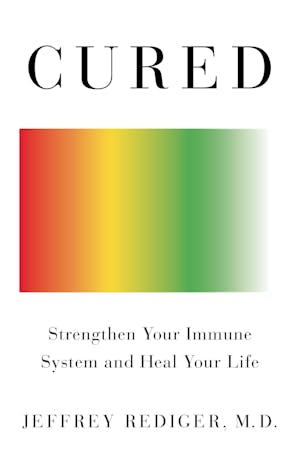
Always curious to know more about how healing happens, I was happy to get my hands on the book Cured: The Life-Changing Science of Spontaneous Healing, by Dr. Jeffrey Rediger, who is on the faculty at Harvard Medical School. While a medical student, Rediger was trained not to pay attention to cases of spontaneous remission of life-threatening illnesses, to consider them unexplainable “flukes.” It wasn’t until years later that he began to wonder what could be learned from such cases. In this book, after seventeen years of studying numerous cases of “spontaneous remission,” he reports that there is a great deal that can be learned about how and why the body heals.
Rediger’s book caught my attention right from the beginning. In the introduction, he tells the story of Claire, a woman diagnosed with an aggressive pancreatic cancer. When caught at a late stage, pancreatic cancer is usually fatal within a year and has an abysmal five-year survival rate. Claire, however, became completely cancer-free within a year of her diagnosis and remained so for about ten years. I was eager to learn about her approach to healing.
After her diagnosis, Claire did a great deal of research. Then she declined the offered medical treatments, which in her late stage case promised lots of pain and only very slim chances of real recovery. Instead, she decided to make some major changes in her way of life, including her diet, lifestyle, emotions, and spirituality. In order to live more fully and authentically, Claire confronted fears and other barriers to living the way she really wanted. She moved to a part of the country where she had always wanted to live. Then she “just let nature take its course.” She explained: “I decided to live with as much zest and happiness as I could for however long I had left.”
For several months after walking out of her doctor’s office, Claire felt worse and worse. Then, slowly, she began to feel better. After a while she felt healthy again. Five years after her diagnosis of pancreatic cancer, during an CT scan for an unrelated abdominal issue, Claire’s doctors were astonished to see that the tumor that had once been in her pancreas was no longer there. She had become a different person than before, with a new understanding of what her life was about and why she was in the world.
Like Claire, the people profiled in Cured for their spectacular cures all wanted to live, and they were willing to make big changes in their lives in order to do so. But another important thing they had in common was that they also made peace with death. They accepted that their lives would end someday. Rather than focus on fighting death, they put their energy and attention into living the best way possible.
When Dr. Rediger began to look into the documented cases of spontaneous remission of “incurable” diseases, he learned that in the last century, “reports of spontaneous remission have slowly increased in both number and frequency, typically with a spike after significant conferences, books, or major media stories.” In the 1990s, the Institute of Noetic Sciences “documented 3,500 references to spontaneous healing across eight hundred journals.” Because the medical profession has generally been uninterested in exploring or documenting such cases, the documented ones are a small percentage of the actual number of such healings. At a large conference, Rediger polled his medical colleagues, asking how many had witnessed a recovery that had no medical explanation. All over the room, doctors raised their hands. When he asked how many had published an article documenting such cases, all hands went down.
Unlike Claire, most of these people profiled in Cured did not walk away from their doctors. As Rediger explains, “many instances of spontaneous remission … occur in concert with the extraordinary efforts of dedicated physicians working at the tops of their fields. Remarkable recoveries simply tell us that these interventions are not always enough and that they do not hold all the answers to healing.” As a doctor, Rediger was trained primarily to focus on ameliorating symptoms of illness. Studying spontaneous remissions taught him that the medical profession still has a great deal to learn about the root causes of illness and how to address them.
Diet, lifestyle, and stress were often the first areas of their lives in which the people who healed made major changes. All of them are areas with important impacts on the immune system, the body’s system of natural defense against illness. In addition to these things, Rediger also discovered that radical healing is deeply connected to, “our thoughts, beliefs, and even our most fundamental, unexamined sense of self.” Recovery of one’s deepest identity, he found, was the basis of much healing. And love, he wrote, “touches and heals something that medications can’t touch.”
One of the early chapters in Cured is entitled “Eat to Heal.” Radical changes in diet were made by the majority of the people he studied, but they did not all make the same changes. In recommending to readers the most health-promoting diet, Rediger pointed to recommendations recently made by thirty-seven leading experts for what they called a “planetary health diet.” Their recommendations were similar to the diets adapted by the people Rediger studied: “far more fruits and vegetables, whole grains, legumes and nuts, and far less meat, dairy, refined flours, and sugars.” These experts recommended that people in developed countries reduce meat consumption by 80%. Rediger advises readers to eat foods with higher nutritional value (“nutritional density”) and avoid unhealthy levels of sugar and salt, found in most processed foods. Sugar is addictive and causes inflammation. Based on what he was seeing in his studies, Rediger decided to stop eating processed foods and refined sugar; he lost forty pounds without making any other changes.
Dietary changes are important and often key to maintaining health or to healing illness, but they are not the only changes that contribute to spontaneous remission. In the second half of Cured, Rediger shares what he learned about reducing stress, in particular about staying in the relaxed and healing parasympathetic mode of our nervous system. Today a lot is being written about the vagus nerve and its role in turning on the parasympathetic mode, which is key to healing. We can engage the relaxation response and shift into the parasympathetic through meditation, prayer, yoga, and other relaxing modalities, but what keeps us in this healing mode, Rediger discovered, is love and connection. He writes, “We know now that the vagus nerve is activated by compassion for others, compassion for the self, and positive feelings in general. We know that what really lights up that circuit is not only relaxation response but also love—micro-moments of positive connection with those you are intimate with and even those you barely know.” I imagine that the deep, spiritual connection to God, others, and life itself that can happen in the Quaker meeting for worship is deeply healing in this way, too.
To illustrate the point that positive and loving connections with others can be even more important than eating healthy food, Rediger cites the famous case of the tight-knit community in Rosetan, Pennsylvania in the 1960s that had uncommonly low rates of heart disease in spite of a dietary culture high in fat and cholesterol. What preserved the heart health of the Rosetan community? They were “gathering together around meals, maintaining extraordinarily close family ties. They found joy and community around the sharing and experience of food.” Community ties, a healthy sense of identity, and joy have great healing effects.
Part Two of Cured is called “The Miraculous Mind” and begins with a visit to a doctor in Ohio, a devoutly Catholic medical doctor with a background in anesthesiology and surgery who is known not so much for the form of electo-acupuncture he practices but for the divine healing love that flows through him to his patients, some of whom have been healed of “incurable” illnesses. The doctor describes himself as an “energy healer” and believes that prayer is a form of energy. It’s the energy of God that flows through him, he says. We live in a quantum field and everybody has access to that same divine energy. He believes that he is called to bridge science and spirituality.
Rediger describes several of this Ohio doctor’s patients who have had extraordinary healings, including a girl born with cerebral palsy who had been wheeled into his office in a wheelchair and ran out after her first treatment. There is also a chapter about Dr. Patricia Kaine, a medical doctor and single mother who had been diagnosed with idiopathic pulmonary fibrosis, a progressive and ultimately fatal disease with no known cure. After several years of treatments using standard medicine and a steady decline in her lung function, Dr Kaine started treatments with the Ohio doctor known for healing prayer. Slowly she began to improve and gradually her lung condition reversed. Scar tissue in her lungs disappeared, something not known to happen through medical treatments.
When Rediger met the Ohio doctor, he asked to see the files of people who’d “had an incurable medical illness, as well as indisputable evidence of both accurate diagnosis and recovery.” He was given twenty-five such cases and offered more if he wanted them. His study of these patients led Rediger to a deeper study of the placebo effect and then to a study of quantum physics and the implications it has for healing in the human body.
Rediger had long been intrigued by a spontaneous healing that had happened in a Boston hospital where he was working. A patient diagnosed with multiple myeloma, considered to be “an incurable and eventually fatal” disease, came in because of severe pain in his back. A CT scan showed that a tumor in his spine was lodged between his vertebra. Surgery was scheduled to relieve the pressure on the spine. The day before the scheduled surgery, just a few days after the CT scan, the patient was put into an MRI machine, a standard pre-op procedure so that the surgeons could have better images of the tumor they hoped to remove. While inside the MRI, the patient had a visionary mystical experience– or a strange dream–that left him feeling “oddly calm.” Afterwards, the images taken by the MRI showed that the tumor was “nearly completely resolved.” Surgery was canceled, and the medical professionals at the hospital were left to ponder the mystery of what happened. When Rediger checked with the patient years later, he was still doing well. One of the quantum physicists whom Rediger consulted during his study of spontaneous healings told him that “quantum mechanics, as he understood it, absolutely supported the idea that the mind had a role to play with physical health—and even more broadly with the world around us.”
When it comes to health and healing, many things can play a role: diet, exercise, eliminating stress, quieting the mind of mental chatter, letting go of constricting beliefs, getting out of unhealthy situations and unsupportive relationships, and opening to more connection and to love itself. Rediger’s search led him to the conviction that there is something even more fundamental than all of these changes. Most of the patients who had spontaneous remissions had also healed their identities on fundamental levels. They paid attention to their inner life and shed roles, labels, and masks that were false. Rediger explains that, “we have a whole other identity that is deeper, more complete, more foundational. We aren’t what we do. We aren’t our past actions. We aren’t necessarily the people our loved ones believe us to be. And we certainly aren’t our illnesses. The true self exists, invisibly and mysteriously, beyond all these labels and masks.” Those who had miraculous healing were often those who had the courage to seek their purpose in life and their deepest, true identity.
In his final chapter, Rediger asks readers to discard anything in the book that makes them feel blamed or responsible for their illness, anything that doesn’t resonate or inspire. He wants people to feel empowered. He concludes by writing, “To move forward without feeling judged, blamed, or responsible, it’s important to remember that ultimately, it’s not about the illness. It’s not about right or wrong or about specific things that you do or don’t do that will heal you or not. It’s about getting a life that’s meaningful, where you understand and experience your own worth, and where you know what your purpose is and what you want from this life—however short or long it may be.”
Cured: How have you experienced of your own abilities to heal?
A Guide to Faithfulness Groups explains what faithfulness is and how it can be cultivated by small groups that practice ways to listen inwardly together for divine guidance, a practice that holds great potential for supporting individuals of any faith in allowing the work of the Spirit to become manifest through them and their communities.
Our Life is Love: The Quaker Spiritual Journey describes the transformational spiritual journey of the first Quakers, who were inwardly guided by God to work and witness for radical changes in their society. Focusing on ten elements of the spiritual journey, this book is a guide to a Spirit-filled life, designed to be a resource for both individuals and groups to explore their spiritual experiences. It describes the journey of faithfulness that leads people to actively engage in God’s work of making this world a better place for all. Our Life is Love has been reviewed by Marty Grundy in Friends Journal, by Carole Spencer in Quaker Religious Thought, and by Stuart Masters on A Quaker Stew. The first few chapters of this book are available for download as a pdf HERE.
Both books are available from Barclay Press in hardback and paperback.
Marcelle Martin's book, Our Life is Love: The Quaker Spiritual Journey, explores ten elements of the spiritual experience of Quakers. It is a great resource for study groups to explore these elements of spiritual experience in our own lives. See the Publication page for more information. * * * * * * * *
Marcelle is available to lead workshops and retreats and to give talks. See the Teaching and Upcoming Workshops page.














 A Whole Heart