Seeking

Part Three in a series about The Elements of the Quaker Spiritual Journey.

A deep longing to know God’s ways and the desire to overcome sin moved those who became the first Quakers. Like many of us today, they also felt disheartened by the condition of the world and longed for truth and justice to prevail. In mid seventeenth-century England, many different ways of worship and spiritual practice were offered as alternatives to the status quo. The theological diversity was not nearly as great as what is available today, but the ideas and new practices seemed radical, and there were fierce debates about which were orthodox and which were heretical.

When spiritual longing grows strong, it compels people to seek for a way to live that meets the inner need. Most early Friends began seeking by attending the sermons and lectures of priests and ministers who had a reputation for spiritual wisdom. Some, like George Fox, traveled long distances to seek out those with the highest reputations.

“Non-conformist” clergy were preaching new religious ideas. Only a few decades earlier, the Bible had finally become available in English in an edition inexpensive enough for ordinary people to afford. Often it was the only book a family owned, and each day households gathered together at regular times for the reading of prayers and Bible passages.  Puritans were those who wanted to purify the church of practices and rituals not mentioned in the scriptures. Numerous religious groups had sprung up, each with a slightly different idea about what constituted a true, pure church. They were variously called Independents, Separatists, Dissenters, and Anabaptists; all of them were referred to as Puritans.

Those dissatisfied with the Anglican Church joined one of the new religious sects, seeking the true way that God wanted to be worshipped. They participated in morning and afternoon Sabbath services, read recommended books, attended mid-week lectures, and engaged in spiritual practices such as fasting and abstaining from sports and card-playing on the Sabbath. All the Puritan groups put emphasis on finding clear instructions in Scripture about what God wanted. Within and among the various sects, however, seminary-educated ministers debated fiercely about whose Scripture interpretations were correct.

Yorkshire teenager William Dewsbury begged his family to apprentice him to someone in Leeds, because he heard there were strict Puritans in that town. At Sunday services, he sang psalms, took communion, and wrote down the sermons in shorthand. During the week he fasted and participated in all the other recommended practices. When he had free time from his apprenticeship, he visited the ministers at home and asked them to explain various points they had made while preaching. Even the most educated ministers, however, responded solely from their book learning. They did not speak of direct knowledge of God or God’s ways. None were able to describe to Dewsbury any personal experience of God enabling them to overcome sin: “I met with none who could tell me what God had done for their souls, in redeeming them from the body of sin, which I groaned under, and which separated me from the presence of God; although I walked strictly with them in their outward observances and in running to hear one man after another, called ministers, yet I found no rest nor peace to my weary soul.” (qtd. in Smith, 25)

Elizabeth Hooton, a farmer’s wife, found Anglican services inadequate for her spiritual needs and sought for a more zealous congregation; she joined a group of general Baptists. The Baptists–also called Anabaptists–were among the most radical in the spectrum of Puritan sects at that time. They believed that baptism was only for mature believers, not infants. At their services, the Baptists allowed the ministry of lay preachers, sometimes including women.

Members of all the new religious groups in England were hopeful that when the Civil War was won by the Puritan army, a government would be established more in keeping with God’s righteousness, one in which they would receive religious freedom. The new Commonwealth established after the war proved disillusioning, however, and some of the Baptists Elizabeth Hooton joined lost the heart to continue their religious observances. They decided to play football on the Sabbath instead. Elizabeth Hooton judged that these drop-outs “were not upright hearted to ye Lord but did his work negligently.”( qtd. in Manners 4) Gathering the remnants of the shattered group, she began to hold meetings in her house in the village of Skegby. Her husband was not happy about this. The marriage nearly broke up, but the Hooton children attended the meetings.

In the rural north of England, Francis Howgill had been seeking for decades: “I fasted and prayed and walked mournfully in sorrow, and thought none was like me, tempted on every hand. So I ran to this man and the other, and they made promises to me, but it was only words….” (Early Quaker Writing, 171-172) He joined the Independents and then the Anabaptists, for a time feeling at home among tender-hearted seekers like himself, eagerly joining in all their services and practices and spending his spare income on the books they recommended. Ultimately, however, he was disappointed. The groups he joined were focused on interpreting the words of scripture and talked only about what God and Christ had done in the past. They did not know the living God or the risen Christ by direct experience. Among them, he wrote, “no peace nor no guide did I find.” He became a preacher among those called Seekers, people who were waiting for God to send someone with apostolic power to teach how God wanted them to worship.

In sophisticated London, Martha Simmonds, from a family of printers, searched for a minister who spoke truth, attending a variety of churches, as well gatherings held in public places or in people’s homes: “For seven years together I wandered up and down the streets enquiring of those that had the image of honesty in their countenances, where I might find an honest Minister, …and wandering from one idol’s temple to another, and from one private meeting to another, I heard a sound of words among them but no substance could I find….”(qtd. in Moore, 37)

Reading accounts of the seeking of early Friends reminded me of my own experience of seeking, which began with questions to my Sunday School teachers when I was a child. In my late teens, I left the church of my childhood, unsure that God existed. Like many readers who responded to my recent blog posts about the Ten Elements of the Quaker Spiritual Journey and Longing, I did not know at first that the pain I felt inside was a spiritual longing. In my early twenties, my seeking was directed toward relationships, travel, and intellectual and creative pursuits. Later I began to seek by reading books about spiritual matters, attending different churches, and trying a wide range of spiritual practices. Like Francis Howgill, however, I eventually found that none of my outward seeking led to finding peace or a guide. That did not happen until, like those who became the first Quakers, I looked inward.

The next post will describe the experience of Turning Within.

A bibliography page has been added. To see it, go to awholeheart.com

Seeking: In what ways have you been a seeker? Did your seeking bear fruit?
Sedona 2010 MM crop1

(c) 2013 Marcelle Martin

Posted in Learning from Early Friends | Tagged , , , , , , , , , , , , , , , , , , | 8 Comments

Longing: the First Element in the Spiritual Journey of Early Friends

As a deer longs for flowing streams, so my soul longs for you, O God. My soul thirsts for God, for the living God. When shall I come and behold the face of God? My tears have been my food day and night, while people say to me continually, “Where is your God?” (Psalm 42:1-3)

Part Two in a series about The Elements of the Quaker Spiritual Journey,
as experienced by early Friends and by us in our time.
A bibliography page has been added to awholeheart.com

Mid-seventeenth century England was a time of religious, social, and political turmoil. After searching through the Bible, many concluded that various rituals of the church were man-made rather than God-given. New religious groups developed modified forms of worship.  Some sensed a new spiritual dispensation was about to be given, and there was a widespread expectation that the second coming of Christ would be soon. Conflict developed into a civil war. That ended with the decapitation of the king and the establishment of a new form of government. Things didn’t change as much as hoped, however, and high hopes for the establishement of God’s kingdom on earth were followed by despair and disillusionment. In this time of questioning and upheaval, an intense spiritual longing was felt by most of those who became the first Quakers.

Many of them had felt spiritual stirrings in childhood. As boys, both William Dewsbury and George Fox worked as shepherds; they brought their Bibles with them into the fields and prayed during long hours watching the sheep. Young Mary Proude (later Penington) wrote her own prayers to say upon awakening and before going to sleep: she chose to kneel on the cold floor rather than pray in her bed like a baby.

Human sinfulness was the subject of a great deal of preaching. Sinfulness was believed to be a sign that one was predestined to eternal damnation. Many children were burdened by a sense that their behavior was displeasing to God. Stephen Crisp wrote about his boyhood struggles and fervent desire: “I wanted power to answer the requirings of that in me, which witnesseth against evil in me, and this I lamented day and night. And when I was about nine or ten years old, I sought the power of God with great diligence and earnestness, with strong cries and tears; and if I had had the whole world I would have given it, to have known how to obtain power over my corruptions.” (Early Quaker Writings, 199)

Not only children, but people of all ages despaired when they were unable to stop committing acts which their conscience witnessed to be wrong. Like Stephen Crisp, they were eager for the inward power to overcome sinful behaviors. They wanted to know they were acceptable to God. According to the prevailing theology, however, God was far away, in a distant heaven beyond the earth. Christ, too, was way out there in his resurrected physical body. People longed for a closer connection, and they yearned to know how God really wanted them to live and to worship.

Wealthy Lady Mary Penington’s longing increased after she became a widowed mother. In her spiritual autobiography she wrote: “Oh! the groans and cries in secret that were raised in me, that I might be visited of the Lord, and come to the knowledge of his way; and that my feet might be turned into that way, before I went hence…. I would cry out: “I care not for [an inheritance] in this life: give it to those who care for it. I am miserable with it: it is acceptance with thee I desire and that alone can satisfy me. … I was like the parched heath,…so great was my thirst after that which I did not believe was near me.” (Hidden in Plain Sight, 218)

In some, the longing to know God was not coupled with a sense of personal sinfulness so much as with a growing disgust about the hypocrisy, suffering, and injustice in the world. George Fox was appalled that so many who “professed” to be Christians acted in shameful ways, from the cousin who wanted him to participate in a beer-drinking contest to the judge who acted unjustly. He called these people “professors”–they professed to be Christians, but did not act like it. He longed to meet those who had come into true inward “possession” of the faith they professed, people who could guide him into the same.

For many, then and now, this longing is felt as an increasingly urgent need for meaning and purpose, or as a yearning to live in a world in which truth, love, and justice prevail. When meaning and purpose seem absent, when the world seems unjust or unloving, longing can turn into cynicism and despair.

The innate human desire for intimacy with God is akin to gravity: the small, separated body is attracted to the larger one and drawn toward contact. Whether or not one believes in God, feeling separate from the larger, divine Being can be intensely painful.

At a certain point in my childhood, I began to ask questions of my Sunday School teachers and pondered their responses. In sixth grade I attended my friend’s week-long Bible camp. At the first night’s outdoor service, I went right up to the altar when they asked who wanted to invite Jesus into their hearts. They later told me I was “born again” that night. In the weeks after Bible camp, however, I came to the quiet conviction that Jesus had been in my heart long before that date.

In my twenties there came a time when my spiritual interests turned into a deep longing. My grandfather died in a sudden accident, and someone else I loved had a possibly fatal illness. I was in graduate school and my academic studies no longer seemed important. The published novelists who were my writing professors did not seem to have found the kind of meaning in their lives that I hoped for. In many ways I felt blessed. I had little money, but all the material things I needed, and my family was supportive. I had done lots of traveling, and I’d had some wonderful boyfriends. But now I longed for something more.

At the age of twenty-six, finally nothing was more important to me than understanding what life was really about. My heart ached. I took walks alone at night, under the stars. I yearned for something, but I didn’t know what. I longed to know if God existed and if my consciousness would survive death. I took out the Bible I’d been given long ago. An index card fell on the floor. Written in my sixth-grade handwriting was a quote I’d copied when I was in Bible camp, words from the prophet Jeremiah: Then you will call upon me and come and pray to me, and I will hear you. When you search for me you will find me; if you seek me with all your heart. (Jeremiah 29:12-13) In that time of deep longing, it was electrifying to read this promise that God will be found when one seeks with all one’s heart.

As I have discovered since–and as early Friends testify in the accounts of their spiritual journey– the longing causes one to seek, and those who seek wholeheartedly, find. The next post will describe seeking–as experienced by the first Quakers, and by Friends in our day.

Longing: In what form have you experienced longing? What blocked your sense of longing, and what encouraged it? Was there a time when your longing motivated you to seek?

moonrise crop 1

(c) 2012 Marcelle Martin

Posted in Learning from Early Friends | Tagged , , , , , , , , , , , , , , , , , | 9 Comments

Ten Elements of the Quaker Spiritual Journey

For many summers I lived alone and spent my days reading about early Friends and their times. Summer by summer, I pieced together my own account of the beginning of the Quaker movement. I was fascinated by their collective experience and the powerful way so many of them went into the world proclaiming the radical message of the Light of Christ within, challenging oppression of all sorts. Their stories were dramatic, heart-wrenching, and inspiring. In recent years I’ve looked more closely at the nature of their spiritual experience, asking myself: What, exactly, was the transformation they underwent that enabled them to become such bold witnesses to the truth they discovered?

Through taking up companionship with early Friends, I’ve gained a clearer sense of their collective spiritual journey. In Christian history there have been other individuals and groups who underwent a similar transformation, but the way Quakers spoke about it has some distinctive qualities. Today there is some crucial learning to be gained from them–not only by contemporary Quakers but by Christians and spiritual seekers of all sorts. Understanding the transformation they experienced can help us to become more responsive instruments in God’s hands, more able agents for the service, witness, innovation, cultural change, reconciliation, and healing needed in our time.

The transformation early Friends experienced involved a process of rebirth: a diminishment of the self-centered will–a kind of death–and the awakening of a being given over entirely to doing the will of God. They called this the New Birth. In his Apology, Robert Barclay wrote: “For those who do not resist the light, but receive it, it becomes a holy, pure, and spiritual birth in them. It produces holiness, righteousness, purity, and all these other blessed fruits that are acceptable to God. Jesus Christ is formed in us by this holy birth, and by it he does his work in us.” Through this spiritual rebirth, early Friends became “partakers of the divine nature,” as promised in 2 Peter 1:4. It required giving everything to God; in return, one gradually became wholly united with the fountain of God’s love and transforming power.

I have identified ten essential elements in the early Quaker spiritual journey. These ten elements may unfold or become prominent in stages, but they are not, in themselves, stages of the spiritual journey. They are more like strands that weave through the whole process. In future blog posts, I expect to focus on each of these elements in turn. I would love to hear your thoughts about these aspects of the spiritual journey and to learn about your own experiences of the transforming work of Christ, the Light, within us.

AWAKENING

The journey begins with Longing, a desire for greater intimacy with God. This longing is experienced in many different ways, often as a heartfelt yearning for connection with God, or the need to be obedient to the divine will. Sometimes it manifests as dissatisfaction with the religious beliefs or practices in which one has been raised, or in dissatisfaction with the ways of the world. More generally, one might simply feel a longing for the way of truth or love.

Longing eventually causes Seeking. Initially, most seeking is outward, and may involve attending lectures, reading spiritual books, discussing scripture or matters of religion, joining a new church or spiritual community, and taking up various practices. Seeking may lead to new understanding and to growth in faith, but innate spiritual longing cannot ultimately be fulfilled through outward means.

Turning Within is an essential element of the Quaker spiritual journey. At some point, the seeker discovers that God—Christ, the Light, the Holy Spirit–has been dwelling inside all along, inwardly present in a quiet and humble way that was often easy to dismiss or ignore.

CONVINCEMENT

At the beginning of Quakerism, one did not become a Quaker merely through seeking, or even through discovering the indwelling divine presence. Together, the next three elements of the journey were essential aspects of the process of convincement: Openings, The Refiner’s Fire, and Being Gathered into Community.

Openings include a wide range of divine revelations and direct guidance of the Spirit of Christ within. Openings can be dramatic, but are more often subtle impressions upon the inward, spiritual senses. By “minding the Light,” over time one becomes more sensitive to divine openings, and more responsive. For many early Friends, revelations came in the form of “openings in scripture,” fresh understanding of the meaning of particular Bible passages, with relevance to their lives. Spiritual guidance often came through an inward hearing of certain scriptural phrases or verses.

The Refiner’s Fire is a difficult and usually painful element of the spiritual journey. This biblical metaphor was used by many early Friends to describe the process by which the Light of Christ reveals and melts everything within that resists God and God’s ways. Gradually sin, temptation, and disbelief are cleansed away, as well as overriding cravings for comfort, pleasure, and social status.

Being Gathered into Community is the third essential element in the process of convincement as a Quaker. The community helps its members to stay faithful to God’s transforming work among them, help that is especially needed when one encounters inward and outward resistance. The “corruptions of the world” lose their controlling power and, with the assistance of the community, one becomes increasingly dedicated to God’s purposes. Gradually the faithful person discovers that he or she is bonded with the community in deep, spiritual ways, no longer a separate being but part of the body of Christ.

FAITHFULNESS

The divine presence within provides guidance about how to live in accordance with God’s will; this often involves doing things differently from the cultural norms. At first this guidance is primarily about specific aspects of personal and communal life. As God becomes more and more clearly the center of life, however, individuals and communities receive Leadings of the Spirit that are about doing God’s work in the world, in matters both small and large.

Responding to leadings brings us up against both inward and outward resistance. What God asks involves a sacrifice of time and energy on behalf of others, with diminished gratification of creaturely desires and personal preferences. Something inside us groans at the things to which the Spirit leads us. Giving witness and taking up counter-cultural ways of living also elicits resistance from others. Those who are faithful sometimes lose social status, or experience persecution. Obediently following the leadings of the Spirit therefore leads to the element of the spiritual journey that early Friends referred to as Living in the Cross, or the cross to our wills.

In the experience of early Friends, it was Christ within who carried out the leadings of God’s Spirit and enabled them to bear the sacrifices and suffering that often ensued. God’s power enabled them to be faithful, and they experienced God’s love flowing from within, moving them to risk difficulties for the sake of others. I have called this element of the spiritual journey Abiding in Divine Love and Power.

Early Quakers, like many other Christians before them, understood that the transformation to which they were called led to a state of spiritual maturity called Perfection. It was a state of being able to live perfectly in accordance with God’s will, without any resistance or sin. Friends recognized that people are given different “measures” of the light, and that there are degrees of perfection. As one is faithful to the measure one has received, more is given. Perfection is not a static state. One can fall out of that condition; once in it, one can continue to grow, endlessly.

Several subsequent blog posts describe more about each of these elements of the spiritual journey of early Friends and invite us to reflect on how we can assist each other to be faithful to the transformation and the leadings of the Spirit to which God calls us today.

Sunrise 2012n crop 1

(c) 2012 Marcelle Martin

To read an overview of how early Friends experienced the powerful transformation that resulted from faithfully following the Light of Christ through this spiritual journey, see my 2013 blog post entitled The New Birth.

A Guide to Faithfulness Groups explains what faithfulness is and how it can be cultivated by small groups that practice ways to listen inwardly together for divine guidance, a practice that holds great potential for supporting individuals of any faith in allowing the work of the Spirit to become manifest through them and their communities.

Our Life is Love: The Quaker Spiritual Journey describes the transformational spiritual journey of the first Quakers, who were inwardly guided by God to work and witness for radical changes in their society. Focusing on ten elements of the spiritual journey, this book is a guide to a Spirit-filled life, designed to be a resource for both individuals and groups to explore their spiritual experiences. It describes the journey of faithfulness that leads people to actively engage in God’s work of making this world a better place for all. Our Life is Love has been reviewed by Marty Grundy in Friends Journal, by Carole Spencer in Quaker Religious Thought, and by Stuart Masters on A Quaker Stew. The first few chapters of this book are available for download as a pdf HERE.

Both books are available from Barclay Press.

Find a Quaker Meeting near you: Quaker Finder

Friends Meeting for Worship (a 7 minute video about Quaker Meeting for Worship)

 Whole Heart has a page on Bibliography.

Posted in Learning from Early Friends, Quaker Faith Today, Radical Christianity | Tagged , , , , , , , , , , , , , , , , , , , , , , , , , , , , , , , | 51 Comments

Becoming Whole-Hearted in the Midst of Division

Through study of the charismatic beginnings of Quakerism, I have received a key to the Quaker spiritual journey that can help us  respond to the extraordinary demands of our time and truly become the needed agents of God’s healing we are now called to be.  Deep in my heart I know that what I have to share is a gift from God for us; yet I falter when faced with the task of speaking to a divided spiritual family.  Quakers today span the Christian theological spectrum, and beyond.  We are diverse in belief and practice.  Since I moved to Indiana a year ago, I’ve been in the midst of Friends suffering and grieving because of the painful split in Indiana Yearly Meeting (FUM).  The split involves different interpretations of scripture, different ideals of the role and authority of the Yearly Meeting, different ideas about the inclusiveness of God’s love.

The diversity and divisions among Friends mirror the condition of humanity.  Over a long Thanksgiving holiday, I was acutely aware of how divided my own family is, and my country, as well.  Eleven members of the extended Martin family gathered in Virginia to celebrate Thanksgiving early, against the backdrop of the Shenandoah Mountains.  After that, about twenty people connected to the Hauger family gathered in western Pennsylvania.  Members of the two families came from as far away as New York City and Phoenix, Arizona.  Like our nation, we ranged across a spectrum of political and religious beliefs.  In the Martin gatherings, our passionate exchanges about the presidential candidates were kept brief because tears came so quickly.  Which party was in the majority kept shifting as additional family members arrived.  At a meal with mostly Democratic members of the Hauger family, five-year-old Ethan (nicknamed ChiChi) asked incredulously, “Uncle Nate, did you vote for Romney?”  On Thanksgiving day, however, Nate was in the majority.  That morning we were on a farm where four men dressed in bright orange hunted for pheasants and rabbits, in fields doTreeline 2croptted by blue gas wells.  I could hear gun shots as I peeled ten pounds of potatoes in the kitchen.  In the afternoon, fifteen of us sat down together to share a bountiful meal, preceded by a prayer of thanksgiving.

During the election season, I had been feeling sad about how divided our nation is.  Over the Thanksgiving holiday,  I was reminded that the divisions in this country have a long history.  One day “Gone With the Wind” played for hours on the television, showing hundreds of wounded soldiers and the burning of Atlanta.  Another day several of us watched “Gettysburg,” which vividly depicted scenes from a decisive and very bloody Civil War battle fought on Pennsylvania fields.  That film gave voice to the convictions and questions of both Union and Confederate soldiers.  Some were motivated by ideals of freedom–for themselves, or for all.  Many simply desired to protect the culture and lifestyle dear in their region of the country.  A British witness to the conflict was puzzled because the two sides had so much in common–the same language, the same religion, the same songs.

“But different dreams,” he decided.

Even those of us who nominally share the same religion are deeply divided in our theology–as was true in England when Quakerism began.   On several mornings during the Thanksgiving holiday, before gathering with others, I sat with a laptop and tried to find the right words to succinctly describe the Quaker spiritual journey, as I’ve come to understand it from the writing and experience of early Friends.  During one meal I shared a brief version of this with some family members who listened politely, without comment.  They immediately changed the subject.  I ask myself: Who cares what I have to say about a life surrendered to the Light of Christ within?  How can I describe it in a way that others receive as good news?  How can I possibly communicate through all the different beliefs of those who might be reading these words? 

I am afraid to offend others, and also afraid to be dismissed, mocked, or condemned.   I have named this blog “A Whole Heart” not because my heart is already unified, but because I am learning to become whole-hearted.  I am called to be so.  I believe that early Friends were able to receive so much power from God in part because of how whole-hearted they were.  They, too, lived in a time of deep political and religious divisions.  Quakerism emerged during England’s Civil War, a time of disorienting social change, when numerous Christian denominations were each proclaiming to have found the right way to worship God and to organize the church and state.

Here is the first paragraph that I wrote in western Pennsylvania over the Thanksgiving holiday:

Friends today often wonder why contemporary Quakerism lacks the spiritual power manifested at the beginning.  Those who became the first Friends were whole-hearted in their desire to know and follow the ways of God.  Collectively they were ready to undergo the thorough spiritual transformation that was central to the early Quaker experience.  It involved an utter surrender to the Light of Christ within and among them.  They died to the selves they had been and were born anew, a rebirth that enabled them to live as sons and daughters of God.  If Friends today better understood how God wishes to transform us, we might more fully embrace the divine gift offered in our time, and become more powerful agents of God’s healing of humanity and the planet.

In the next post, God willing, I’ll share ten elements of that spiritual transformation.  May we learn together the singleness of eye and wholeness of heart to which we are all called.

 Shenandoah Mnt1

(c) 2012 Marcelle Martin

Posted in Learning from Early Friends | Tagged , , , , , , , , , , , | 21 Comments

Prepare ye the Way

I planned to introduce here what I’ve been learning from early Friends about the Quaker spiritual journey.  In the meantime, a local train accident has reminded me of a series of dreams about trains. I’ll share them with you, both to introduce something key about the beginning of Quakerism, and as a way to tell you about my own experience.

A couple of years ago, illness threw me from the course I was on, and I was not able to stay in my job.  Shortly after becoming unemployed, struggling with fatigue and depression, I dreamed I had been thrown from a train and was lying in a ditch, covered with dirt and pebbles.  I was given quiet assurance that healing–and restoration–would eventually come.  More recently, I dreamed that I was lying in the grass very close to some tracks.  I was startled when a huge train hurtled toward me.  It was massive, and far wider than I had imagined it could be; quickly I rolled away from the tracks to avoid being hit.  In the dream I sought to resume a certain kind of teaching, but was shown that I needed to rest some more and wait.

For almost thirty years I have been began paying attention to my dreams, and they have often helped me better understand my inner and outer life.  Occasionally there are dreams that seem to be about something more than just my personal experience, dreams that provide insight about the larger culture and our world today.  Some of them are luminous and offer spiritual guidance.

In a dream a few months ago, I was with a group of people on a bridge over a river gorge.  It was a railroad bridge, and we were crowding the tracks as we slowly walked towards a hill visible in the distance.  This was a group of individuals developing their spiritual practices.  I sensed, however, that we would not make it to that distant hill through our own efforts.  A train was available to take us there, if only we would clear the tracks.

Since having that dream, I’ve asked myself: what does that train represent?  How do I clear the tracks for it to come through?  As I’ve prayed about this, it seems that the train represents a transmission of divine spiritual power, which God wants to send collectively to humanity.  To receive it, my heart needs to be cleared.  My personal will needs to surrender to the intimate presence of Christ, moving through me.  For many weeks now, during almost entirely silent mid-week meetings for worship with Clear Creek Friends, I have been experiencing Jesus working in me, with me, to “clear the track,” or in the words of Isaiah (40:3), to make straight in my heart “a highway for our God.”

Spiritual practices help us to prepare for and cooperate with the work of the Spirit.  However, it is not personal efforts but only divine power that can transport an individual or group into another spiritual condition.  In contrast to walking, a train represents a collective form of transport.  It seems that God often works most powerfully when gathered groups collectively surrender to the divine will.  Scriptures give us examples of this, including the band of prophets in 1 Samuel 10:5-10.  Saul is given “another heart” by God, and when he comes among this prophetic group, he begins to prophesy, too.  Even more notable is the descent of the Holy Spirit upon the disciples waiting in the Upper Room on Pentecost (Acts 2:1-21).  At the beginning of the Quaker movement, many of those who became the first Friends had awe-filled experiences of God’s Spirit powerfully active among them in their extended meetings for worship.  Edward Burrough described such experiences as similar to Pentecost:

“While waiting upon the Lord in silence, as often we did for many hours together, with our minds and hearts toward him, being stayed in the Light of Christ within us, from all thoughts, fleshly motions, and desires, in our diligent waiting and fear of his name, and hearkening to his Word, we received often the pouring down of the Spirit upon us, and the gift of God’s  holy, eternal Spirit, as in the days of old, and our hearts were made glad and our tongues loosed, and our mouths opened, and we spake with new tongues as the Lord gave us utterance, and as his Spirit led us.”

Burrough’s partner in the traveling ministry, Francis Howgill, wrote, “the Kingdom of Heaven did gather us, and catch us all, as in a net: and His heavenly Power at one time drew many hundreds to land.”

Early Quakers developed communal spiritual practices that served them well in opening to spiritual transformation and supporting faithfulness to divine leadings.  Many of those practices still serve today.  The key to the power in the early Quaker movement was not their practices, however, but how they made way for the Light of Christ to reign within and among them.  In future posts l will describe ten elements of the spiritual journey of early Friends, a transformation they described as the new birth–being made into new creatures, and, through Christ, “partakers of the divine nature.” (2 Peter 1:4).

I hope you will join me in collectively learning how to prepare the Way for everything God wants to do in us and in our world today!

(c) 2012 Marcelle Martin

Posted in Learning from Early Friends | Tagged , , , , , , , , , , , , , , , , , | 7 Comments

Electing the One Who Heals

When my sister was finally able to email again, after four days without electricity, she said everyone south of 40th street in Manhattan lost power.  Without refrigeration, food in the grocery stores spoiled.  Cold drove her and her husband to move in with some uptown friends.  On the web I saw vivid images of the aftermath of Hurricane Sandy: New York City streets under water, flooded tunnels, and before-and-after photos of the ravaged New Jersey shoreline.

A video showed one of our presidential candidates speaking to his party’s convention, rolling his eyes and mocking the other candidate for wanting to slow the rise of the oceans and heal the planet, apparently unconcerned about such things himself.  The convention crowd cheered him, waving the red, white and blue.  Then the video showed the U.S. flag flapping helplessly in a strong wind, foaming waves pounding the shore around it.  There were scenes of flooded streets, cars engulfed by water, a house collapsing into the ocean, people being rescued in boats and sleeping in shelters, and then the words: “Climate Change is Not a Joke.”

Personally, I would love to be able to vote for a candidate who could slow the melting of the polar caps, prevent the rise of the oceans, and retain the amazingly stable, temperate weather conditions we have known for a long time.  This summer farmers across the Midwest, including those near where I live in Indiana, lost crops to drought and relentless heat.

After enjoying a swim during a heat wave at the end of June, my partner, Terry, and I drove through Barnesville, Ohio as the sky turned ominously dark.  Within minutes of getting into the car, a wind wildly lashed tree limbs and street lights.  The electricity went out in the buildings we passed. Flying objects slammed into the car, and I feared the windshield would break.  Sheets of rain obscured our view, and then came hail.  Wanting some protection, we pulled up beside a building, and sat there, quaking, until the wind died down.

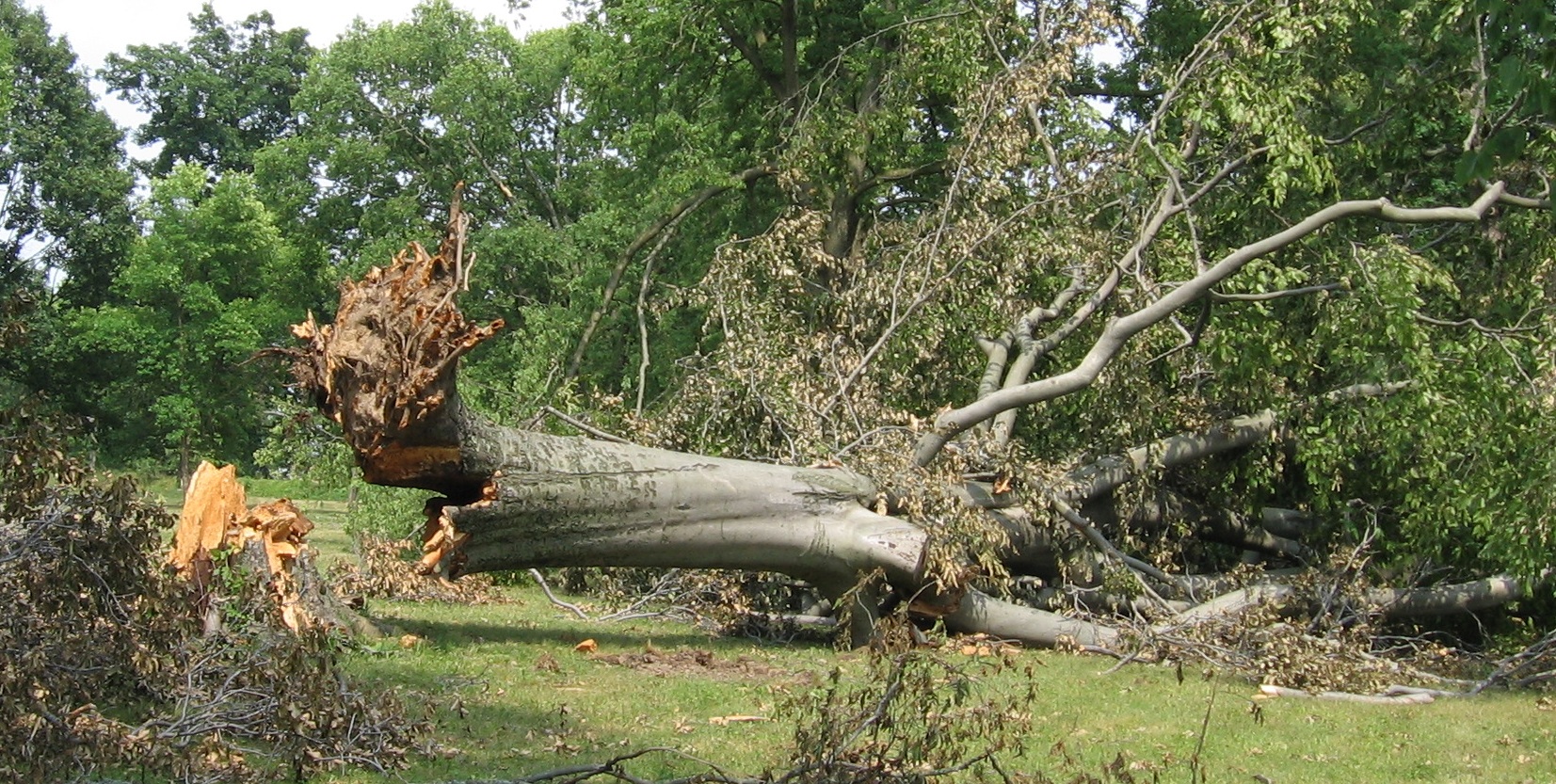
When we were able to drive again, we saw that a huge old tree lay across a street not far from us, and a porch roof had fallen down.  In Cambridge, Ohio, the Catholic Church had almost entirely collapsed; only the front facade was left standing.  Other buildings on the same street lost their roofs.  Initially we imagined it was a local storm, but that evening’s news reported that we had been part of a very unusual weather event called a derecho, described on Wikipedia as “one of the most destructive and deadly fast-moving severe thunderstorm complexes in North American history.”  With winds up to 91 miles per hour, it brought down big trees all the way from Indiana to Maryland, Virginia, and Washington, D.C., causing millions of power outages, many lasting for days.  During the storm, as I trembled in the back seat of the car, I wondered where my faith was.  It required some deep breaths before I could begin to relax and trust that God was still present.

We have already set in motion climate changes that neither presidential candidate can stop, even if this country were to unite today in a resolve to face our real situation and address it.  Perhaps some of those changes can be slowed.  Surely, if we find the clarity and sufficient unity–or when we finally do–we can collectively learn to live on this planet in new ways.  We don’t have to wait for unity, however, and we must not depend upon outward leaders to shape a healing response.  More and more people have been hearing a call to envision and work for a future in which humanity lives in sustainable harmony with the earth.

And all of us have an inner Guide who can teach us how to make the changes necessary for humanity to continue to inhabit this lovely planet.  Faith that resides only in the head is of little help in a big storm.  For most of us, it takes a storm or some other discomforting experience to motivate us to drop our attention into the heart.  There, beyond the limits of our mind, we can find the divine presence which is already within us.  If we become inwardly quiet and let go of fear, we can attend to the guidance of the Spirit–the inward teaching of Christ, the instruction of Holy Wisdom– and find the leadership we need to face the current reality of our lives on earth and make the changes required of us.

We can’t prevent storms from uprooting ancient trees

We can’t keep the sea from changing our shorelines

We can’t stop the oceans from rising

But we can elect the Leader who heals.

We can listen to the still small voice of the Creator

We can take the hand of the One

who is with us through the storm.

We can learn from the Teacher who knows

the Way to abundant life.


(c) 2012 Marcelle Martin

Posted in Uncategorized | Tagged , , , , , , , , , | 10 Comments