
A couple of hours before my faithfulness group met, an unexpected event triggered strong emotions. I had waited a few months for my turn to give a presentation, and I was dismayed to be in such an emotional state when the day came. I had planned to coolly bring a discernment question. In the moment, however, I felt it was important to offer my whole, authentic self to the group and to speak about my distress, which was related to low-paid compensation for my work. It was embarrassing to admit that in relationship to my ministry among Friends, there are moments when I feel sad, afraid, and angry. However, these trusted Friends had been my spiritual companions for a long time. I knew they would listen in a supportive, loving, and helpful way. That day, my freshly plowed-up distress helped me overcome my habit of withholding certain difficult truths and painful emotions.
Later, group members thanked me for being vulnerable and sharing so honestly. I was grateful to them for lovingly holding what I said in their hearts. Their gentle questions helped me to look more deeply into the causes of my distress and also, eventually, to affirm my path, even with its difficulties. By the end of my time in the group’s focus, I was able to see more clearly and deeply appreciate the larger context of divine love and care in my life. I felt deeply grateful for the freedom I’ve had in my life to follow my call. That time as the focus of my faithfulness group was very healing. It freed me to move on from my distress to my next steps, with a grateful heart.
Faithfulness groups (by a variety of names) have provided an immensely helpful support to me in carrying out a call of spiritual nurture to individuals and communities. Four years ago, I felt a leading to share as widely as possible the practice of faithfulness groups (also called mutual spiritual accountability groups or peers groups). I’ve done so in a variety of ways, including the publication of A Guide to Faithfulness Groups. A web page about Faithfulness Groups contains links to many kind of helpful resources, including videos, documents, and an audio recording.
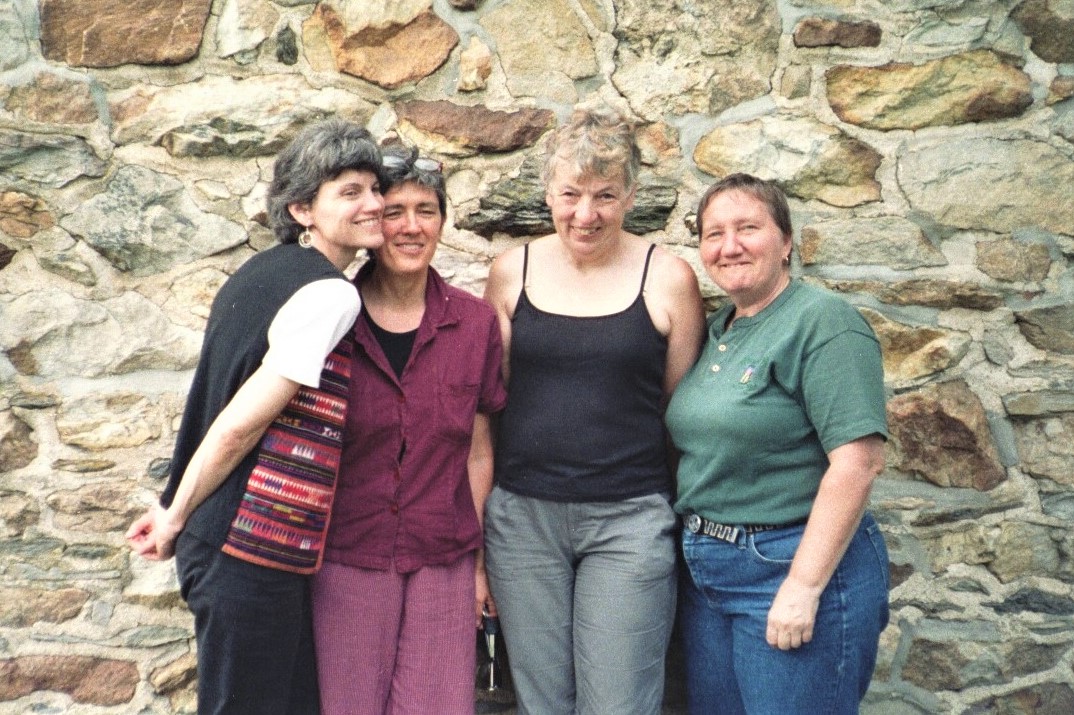
Members of a faithfulness group.
Below is some text from A Guide to Faithfulness Groups (from pages 67-69) about
The Potential of Faithfulness Groups.
Human beings are created with the capacity to be filled with divine love, to live in harmony with God’s will, and to be dedicated to contributing to the greatest good that is possible. We have spiritual senses that can tune us into the loving guidance and energizing power of the Spirit. Faithfulness groups encourage their members to greater boldness in listening and responding to God’s call. For many, this results in a greater willingness to speak truth clearly and an increased ability to love, forgive, and serve others. Some people find they are called to make radical changes or to take great risks for the sake of manifesting God’s love, truth, and justice. A faithfulness group can make God’s work possible by supporting the careful discernment of such a call and helping members make required changes and take the necessary steps. Often, the support and participation of many is needed for faithfulness to become possible.
In our time, we are being called to shed our overemphasis on independence and to focus more on life lived deeply with and for each other. In faithfulness groups, as we open authentically to each other and more trustingly to the divine Presence, we soften our hardened, self-protective boundaries and discover more fully the greater love that unites us with one another in the wholeness of God. Quakers have often had the experience they refer to as a “gathered meeting” in their meetings for worship, an experience of collectively being drawn into a deeper union with one another in the Spirit. This experience can also happen in the silences and prayerful accompaniment of a faithfulness group. Together, members learn to sense the Spirit and hear more clearly the truth of God’s guidance for each and for all. The more people practice this skill with each other, trustingly and whole-heartedly, the better able they are to access this state in other situations, with other people, including the wider group of their faith communities. Faithfulness groups cultivate capacities that are growing in the human race and that can become more accessible to all.
… In certain periods in history, it is exceedingly difficult for individuals or groups to go beyond the norms of their times. But at other times, the winds of the Spirit can move powerfully through groups of attentive, faithful people who mutually support each other. It is possible for human beings to waken from the trance of cultural norms, cultivate spiritual sensitivity, and work together to create societies that encourage a new way of life on earth. In our time, this can happen more rapidly than ever before and on a wider scale. It is possible for humanity to live into a hopeful future as we face the enormous challenges and changes that are present and coming in our time. In faithfulness groups, we can help each other activate potentials of the Spirit that we did not previously believe were possible, abilities to receive divine knowledge, to heal, and to connect with other people and the planet on deep spiritual levels. There is great evolutionary potential in small groups of people meeting regularly to help each other pay attention to the Spirit, waken to the Presence of God, fully incarnate the Light of Christ within, and take the leaps of courage and faith that will help us move in the direction of the new and renewed ways of living to which we are being called.
The Power of a Faithfulness Group © 2020 Marcelle Martin
The best gifts can’t be wrapped.
Being lovingly present with another person in a way that helps them attend more deeply to themselves and to the presence of God with them is a better gift than any material object. Certain conversations are luminous in my memory, times when another person’s or a group’s listening and gentle questions have helped me express truth that I had been concealing even from myself. I treasure the moments when others have helped me listen to hidden aspects of myself that I might otherwise have neglected, or encouraged me to pay attention to grace I’ve experienced or to fleeting guidance that has lighted my way on the path of faithfulness.
We can learn skills that help us listen to other people in a way that allows them to access and express the truth in their hearts. First of all, we learn to quiet our own minds as we listen to another. It’s natural for an inner commentary to take place when we hear someone speak, but we don’t have to give attention to that commentary. We can let it go and learn to listen without judgment, analysis, or opinions. We can be quietly present in a way that allows the sacredness of the other person and of the moment to fill our attention. We can learn to listen not only to the words they say but also to the way in which they speak, the tone of voice, to their joy or sadness, their fear or enthusiasm. We can pay attention to the language of their body, such as the arms folded over the chest, the constriction in the throat, or the radiance that comes when people are speaking their deepest truth. We can attend, also, to the silent presence of what more wants to be said.
When someone shares their pains or challenges, most of us are quick to offer suggestions or opinions. At times these can be helpful, especially when solicited, but a deeper kind of listening can help someone tune in to their own inner knowing and to divine guidance. In the long run, helping another person to attend to the trustworthy source of wisdom within is far more helpful than suggestions, however wise.
Offering questions can be an important part of deep listening, if the questions are simple and their purpose is to help the speaker explore their inner knowing more fully. Some questions ask for factual information. Other questions invite the speaker to engage in intellectual reflection or analysis. These questions have their uses, but another kind of question is designed to help someone pay attention to the movement of the Spirit within them, or to the work of God in their lives, minds, and hearts. Our culture generally does not encourage us to pay attention inwardly, and most of us miss the subtle movements and and whispered guidance of the divine voice within. A question that helps evoke our awareness and draw our attention to the presence of the divine is a great gift, along with our loving willingness to be with another person as they explore this.
Asking evoking questions requires self-discipline on the part of the listener, the discipline not to insert our own opinions or stories, the discipline of really being present for the sake of the other person’s discovery of their truth. The one who offers the question must also be listening inwardly, as we search for the simple query that can invite our friend into deeper exploration and expression.
What seems to most help or hinder your attentiveness to God?
What images or phrases or scripture passages seem to be sources of guidance at this time?
In which situations do you feel you are most authentic and faithful to what you were most truly made to be?
If we pay attention carefully as the speaker tells us about their inner and spiritual experiences, we may notice that when they say something tears come, or a radiant smile. At such moments the best way to help the speaker explore more deeply is simply to ask them to say more about where the tears or smile are coming from. Or if they have described a moment of grace, we can invite them to return to that and say more about it. When we help another person look more deeply–in a feeling rather than analytical way–at how God has been at work in them and in their life, or if we help them go back to a moment of grace and savor it, they may notice more about how the Spirit is with them, guiding, teaching, healing, or loving them. This may unlock hidden insights or truths waiting to be brought into awareness and expressed.
What do you experience when you pray about what God is asking of you?
In this new 8 1/2-minute video by Rachel Guaraldi, several Friends speak about our experience of using evoking questions to help another person listen inwardly to the wisdom and divine guidance that is available there.
Evoking questions can be used in spiritual friendships, clearness committees, faithfulness groups, spiritual direction, and any situation in which there is an intention to help another person explore more deeply their experience and awareness of God and the divine presence. It is a priceless gift, more valuable that diamonds, rubies, computers, cars, or anything material.
How is the Spirit working within you? What are you learning?
© 2020 Marcelle Martin
A Guide to Faithfulness Groups explains what faithfulness is and how it can be cultivated by small groups that practice ways to listen inwardly together for divine guidance, a practice that holds great potential for supporting individuals of any faith in allowing the work of the Spirit to become manifest through them and their communities.
Our Life is Love: The Quaker Spiritual Journey describes the transformational spiritual journey of the first Quakers, who were inwardly guided by God to work and witness for radical changes in their society. Focusing on ten elements of the spiritual journey, this book is a guide to a Spirit-filled life, designed to be a resource for both individuals and groups to explore their spiritual experiences. It describes the journey of faithfulness that leads people to actively engage in God’s work of making this world a better place for all. Our Life is Love has been reviewed by Marty Grundy in Friends Journal, by Carole Spencer in Quaker Religious Thought, and by Stuart Masters on A Quaker Stew. The first few chapters of this book are available for download as a pdf HERE.
Both books are available from Barclay Press in hardback and paperback.
Find a Quaker Meeting near you: Quaker Finder

 A Whole Heart
Marcelle,
This is lovely. Thank you.
Mary
Thank you, Mary!