In Laudato Si, Pope Francis called for an urgent re-examination of how we care for our home, the Earth. In The Nutmeg’s Curse, award-winning Indian-born author Amitav Ghosh continues the conversation about what is needed to address the growing climate catastrophe. His book asks us to see the roots of the crisis going back several centuries. He brings readers in immediately with a gripping account of the 1621 Dutch takeover of the small Banda Islands in Indonesia. In the seventeenth century, the Dutch East India Company was determined to secure control over the world’s source of nutmeg, which originated on those islands. A prized spice, nutmeg was considered an exceedingly valuable commodity in Europe in that era, and the Dutch East India Company wanted to maximize their profits from it by creating a monopoly on nutmeg production.
However, the native people of the Banda islands resisted efforts to be colonized. During a night when tensions on the island were high, the Dutch captain in charge of a company of soldiers was startled by a lamp falling in the room where he was sleeping. When the lamp smashed on the floor and woke him up, he was convinced there was a conspiracy and ordered his soldiers to shoot into the dark. Soon he ordered a brutal massacre of the island’s leaders. Subsequently, the Dutch expelled or exterminated most of the native population, retaining only enough of the local people, now enslaved, to continue the cultivation of the nutmeg trees. Other enslaved people were brought in to help with the work. This event in 1621 set a model for subsequent colonial takeovers by Western European nations on continents all over the world. The Nutmeg’s Curse describes the shaping and spread of the extractive, colonial mindset that has caused great global destruction.
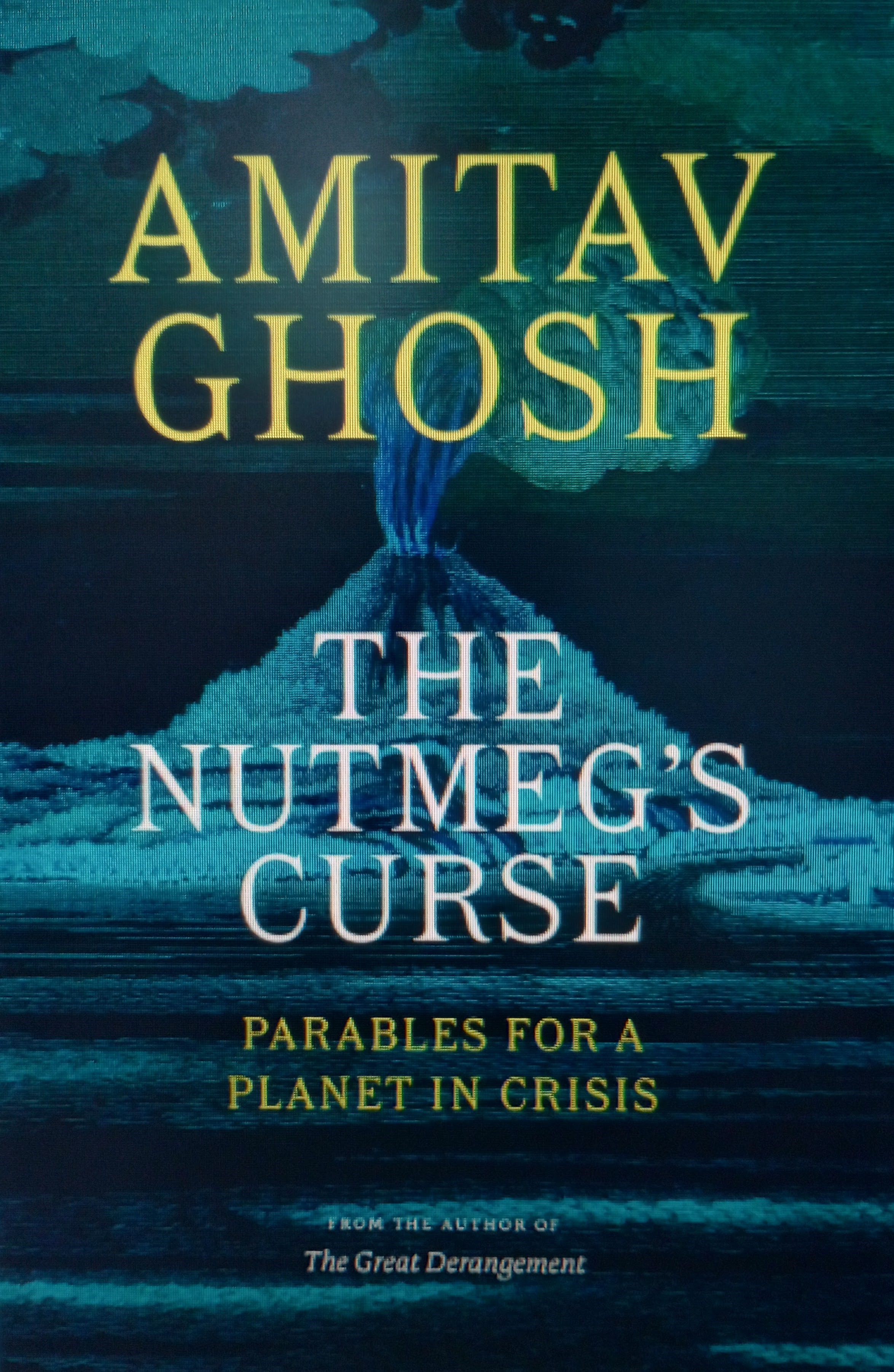
Ghosh argues that the climate crisis is not only a product of burning fossil fuels or industrialization, but the culmination of centuries of conquest, in which the colonial powers treated both people and land as resources to be exploited. In order to justify their behavior, he writes, European intellectuals first had to persuade themselves and then others that the earth was dead and that non-Europeans were not fully human. Ranging over continents and centuries, Ghosh shows how carrying out the violent suppression of people and destruction of ecosystems that was supported by this worldview has led incrementally to the ecological collapse now underway across the Earth.
Subtitled Parables for a Planet in Crisis, Ghosh’s book describes the conquests of numerous particular Indigenous peoples and their cultures, and details how European colonists “terraformed” the landscapes they dominated, in an effort to use them like the lands which which they were familiar. The stories in this book reveal that for centuries Europeans and their descendants have lived under the spell of a worldview that sees land as “property” and nature as “resources,” whose only purpose is human use. This approach to the Earth has been accompanied by an insistence upon a supposed superiority of white Europeans that denies the full humanity of others, especially of Indigenous and Black people. This worldview has not only shaped economies and governments, but fundamentally colonized imaginations and the capacity for sensitivity to the intelligent, living quality of the natural world.

What resonates most strongly from my reading of The Nutmeg’s Curse is Ghosh’s insistence in the final chapters that the Earth is active and alive. He reminds readers of older ways of being in relationship with the planet, of Indigenous peoples who have known the forests, rivers, mountains, winds, and all creatures to be full participants in the living world. In their various ways, Indigenous peoples everywhere have seen the Earth as a living presence with power and agency. Ghosh suggests that this power and agency, though oppressed, ignored, and hidden, is still active. In fact, it is fighting back.
The Nutmeg’s Curse tells more than the story of domination and spreading destruction. It is also an evocative invitation to reconnect with the natural world and to learn from the peoples who still can sense and communicate with the living qualities of the Earth. Ghosh names a few spokespeople for Indigenous traditions who have taught how the Earth is alive, full of spirit. He tells stories of communities and movements that have resisted domination and carried forward relationships with the land based on reverence, mutuality, and care. He gives examples of healthy cultures that have embraced diverse religions and ethnicities and centered themselves on a shared connection to the land and commitment to protect it.
The Nutmeg’s Curse is, at heart, a call to unlearn the colonists’ false story of separation; it’s an appeal to return to the deeper truth that we belong to the Earth and can only thrive if we come together with love and respect for the living intelligence of the planet and the interdependence of all its creatures. In order to participate in planetary healing, we will need to do more than reduce the burning of fossil fuels, cease destroying ecosystems, and find technological solutions. What is needed even more fundamentally is a profound awakening of sensitivity to realms of reality to which Western culture has been deadened for many centuries.
Caring for the earth is fundamentally a spiritual issue, as Indigenous cultures have always known. In 2015 Pope Frances directed world-wide attention to this in his second encyclical letter, “Laudato Si: On Care for Our Common Home,” in which he wrote that, “The universe unfolds in God, who fills it completely. Hence, there is a mystical meaning to be found in a leaf, in a mountain trail, in a dewdrop, in a poor person’s face. Standing awestruck before a mountain, we cannot separate this experience from God.” (233). In the encyclical he addressed environmental degradation and climate change, highlighting the connection between social justice and the environment, and urgently appealing for radical action in support of seven goals, including ecological economics, adopting sustainable lifestyles, community resilience and empowerment, ecological education, and ecological spirituality. Ghosh writes that, “Pope Francis speaks to more than a billion people, and has already done more, perhaps, to awaken the world to the planetary crisis than any other person on Earth” (243-244).
The Nutmeg’s Curse leaves readers with some important questions. What would it look like to listen deeply and find guidance from the living world? Can we participate with the Earth not as abusers but as passionate protectors?
Reading this book reminded me of encounters I’ve had in which an animal, or a rock formation, or a whole landscape seemed to communicate something in a powerful way. In an earlier blog post, Beckoned by Trees, I wrote about a beautiful tree near my home that seemed, silently, to call to me and then, over time, to befriend me. Spending moments close to this tree; getting to know it; appreciating its largeness, beauty, and vitality; leaning against its trunk; and sensing what it might be communicating, helped me find answers I was seeking and taught me to understand my place in the world in a different, more humble and honest way. I pray that we can all, collectively, open ourselves to a deeper awareness of our true relationship with the earth and all its peoples and creatures. I pray that we might find and walk the path of planetary healing.

Hidden Forces: The Living Earth and The Nutmeg’s Curse: How has the Earth communicated with you? How have you been drawn into a deeper, truer relationship with the living world?
© 2025 Marcelle Martin
A Guide to Faithfulness Groups explains what faithfulness is and how it can be cultivated by small groups that practice ways to listen inwardly together for divine guidance, a practice that holds great potential for supporting individuals of any faith in allowing the work of the Spirit to become manifest through them and their communities.
Our Life is Love: The Quaker Spiritual Journey describes the transformational spiritual journey of the first Quakers, who were inwardly guided by God to work and witness for radical changes in their society. Focusing on ten elements of the spiritual journey, this book is a guide to a Spirit-filled life, designed to be a resource for both individuals and groups to explore their spiritual experiences. It describes the journey of faithfulness that leads people to actively engage in God’s work of making this world a better place for all. Our Life is Love has been reviewed by Marty Grundy in Friends Journal, by Carole Spencer in Quaker Religious Thought, and by Stuart Masters on A Quaker Stew.
Both books are available from Barclay Press in hardback and paperback. Marcelle’s books (as well as her Pendle Hill pamphlets) can also be ordered from the Pendle Hill online bookstore.
Find a Quaker Meeting near you: Quaker Finder

 A Whole Heart
Dear Marcelle,
Thank you for that wonderful review. I’ll go now and re-read “Beckoned by Trees “
Glad you like the review–and “Beckoned by Trees”! Thanks for leaving a comment!
thanks, Marcelle !
You are welcome, Homer!